Book Discussion Guide

Hello, Book Clubs. This page is for you! A brief introduction to the story, some suggested questions you can use to get a discussion rolling, and a Q & A with me, the author.

And by the way, I would be delighted to be involved with your book club. I can join you by speaker phone, Skype, or in person (if you are in the southern California area). Contact me at JeriWesterson at gmail dot com.

INTRODUCTION

In late 14th century England, Crispin Guest is a man adrift in a culture where position is rigidly defined. Once a knight, a member of the upper tiers of society, Crispin was convicted of treason and stripped of his rank and his honor for plotting against King Richard II. Having lost his patron, his friends, and his position at court, and with no trade to support him and no family willing to acknowledge him, Crispin has turned to the one thing he still has—his wits—to scrape a living on the mean streets of London.

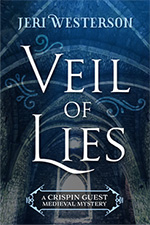
VEIL OF LIES

Acting as the “Tracker”, a personal sheriff, Crispin is called to the compound of a successful but reclusive cloth merchant who suspects his wife of infidelity and wants Crispin to look into the matter. In dire need of money, Crispin reluctantly agrees and discovers that the wife is indeed up to something. But when he comes to inform his client, he finds the merchant dead in a sealed room, locked from the inside. Now Crispin has come to the unwanted attention of the Lord Sheriff of London and finds himself in the middle of a complex plot involving dark secrets, international intrigue, and a missing religious relic—one that lies at the very heart of this heinous and impossible crime.

BOOK DISCUSSION GUIDE

Cast of Characters

Crispin Guest, the Tracker
Jack Tucker, his servant
Gilbert and Eleanor Langton, owners of the Boar’s Tusk tavern
Simon Wynchecombe, the sheriff
William, his sergeant
Adam Becton, steward to the Walcote household
Nicholas Walcote, mercer
Philippa Walcote, his wife
John Hoode, Walcote’s servant
Dickon, the butcher
Martin and Alice Kemp, the tinker and his wife
John of Gaunt, the duke of Lancaster
Costanza of Castille, his wife
Abid Assad Mahmoud, Saracen
Lenny, thief
Sclavo & Two-Fingers, henchmen
Bernarbo Visconti, the duke of Milan
Lionel and Maude Walcote, brother and sister-in-law to Nicholas Walcote
Clarence Walcote, brother to Lionel and Nicholas Walcote
Malvyn, the gaoler
Harry, Clarence’s valet
Michael, Lionel’s valet

QUESTIONS FOR DISCUSSION

1. How do you think the London setting informs the story?

2. There were many small clues dotting the plot. When you look back over the story, what were the significant clues that you missed the first time? And what did you think of the twists?

3. Class structure is an important aspect of Crispin’s character. How did it affect his relationships with Phillipa? With Jack? With Eleanor and Gilbert?

4. What would you like to know about Jack Tucker?

5. Is the sheriff’s motivation for violence justified?

6. Did the Mandyllon really have the power that was attributed to it?

7. Upon Crispin’s refusal, Phillipa quickly accepted Clarence’s offer. Why would she do that?

8. What is underlying Crispin and Lancaster’s strained relationship? What can be done to fix it?

9. Who were the characters that sparked the most interest?

10. Do you see London as a character? The Boar’s Tusk?

11. Were you disappointed that Bernarbo Visconti remained “offstage”?

12. Is the story enhanced or was it a distraction to have the underlying “hard-boiled” aspect to this historical mystery?

Questions for Jeri Westerson on Veil of Lies

What is Veil of Lies about?

VEIL OF LIES is my own little subgenre, what I call a “medieval noir,” a darker storyline than you might find in medieval mysteries, with a hard-boiled detective. Crispin is an ex-knight, having lost his wealth, his title, his status—in short, he’s lost himself and now has to redefine his role on the mean streets of 14th century London. He found his niche by becoming the “Tracker,” my take on a 14th century private eye. He’s an interesting man; dark, brooding, a bit intense but very sharp. Likes to quote Aristotle. He’s much smarter than I am!

In this first in the series, Crispin is hired by a rich merchant to spy on his wife to see if she is unfaithful. When Crispin discovers that she is, indeed, up to something, he returns to the merchant to tell him the bad news, but the man is found dead in the proverbial locked room. What follows is a nest of lies and dangerous secrets involving international intrigue, a beautiful femme fatale, and a mysterious religious relic.

What made you decide to write medieval mysteries?

I wanted very much to write historical fiction. I’ve always been a huge fan of historical novels. I grew up with them at home as well as a glut of history books on the Middle Ages. With an Anglophile mother and a father studying to teach medieval history, it wasn’t uncommon to have a discussion at the dinner table about the British monarchy or some other point of English history. So when I decided I was going to try for a career as a novelist it wasn’t a great leap to choose historical fiction. With a heady background in history under my belt, I began to write and spent ten years writing novels and trying to get published. It was a no go. This was a time when historicals were all but dead and they were a tough sell not only to editors but to agents. I did manage to land an agent and she worked hard trying to place my manuscripts. Eventually, she suggested that I try writing medieval mysteries instead as something more marketable. I really had no interest in writing mysteries, mostly because I didn’t think I could! But like anything you try, you merely have to give it a bit of research to understand what needs to be done. In the end, all novels are really mysteries when you get down to it. The reader doesn’t know who is important in the story and they don’t know how it’s going to turn out. So I learned to write a medieval mystery, giving it that added twist of going darker and edgier and coming up with what I call “Medieval Noir.”

What led you to write a medieval noir, creating your own subgenre?

When I sat down to write a medieval mystery, I knew I didn’t want to go the traditional route. I wanted to take the genre a step further, and when the idea came to me to put a hard-boiled detective in a medieval setting, I knew I had something unique, something that I would be eager to write. It’s a good blend of my love of history and my love of the noir detective fiction of the past. The idea of “medieval noir” came to me pretty quickly. When I mentioned it to friends and family they didn’t seem particularly enthusiastic. But I knew it was a winning idea. It took about two years of thinking about it and kicking ideas around before I put finger to keyboard because I knew I had to make this shot count.

What authors have influenced and inspired you?

Quite a few. How much time have we got? My first influence from years ago when I was a teenager and finished my first full-length novel was J.R.R. Tolkein. This was the first instance there was a surge of interest in the Lord of the Rings saga. I never knew such books existed and I was interested in the world-building of the fantasy novel. Later it was the hard-boiled fiction of Raymond Chandler and Dashiell Hammett. Dorothy Hughes inspired the noir strokes in my current fiction.

What were your particular challenges to writing in this time period?

The challenges in the book are the same challenges in any book: how to make the plot believable. Getting into the mindset of the period is the fun part. I don’t really “make up my own rules.” I allow my characters to work within the rules of the society in which they lived. After sunset, a curfew is enforced and so now the only ones out on the streets are usually up to no good. It’s dark inside one’s lodgings except for a small fire in your hearth—your light and heat. You light a candle or oil lamp to chase the dark, but it’s still pretty shadowy. These are things I can use rather than having them be an obstacle in the story.

That being said, it must be explained that there were no private eyes in medieval England. The conceit of the character is in the “what if” factor: What if a man with his intelligence and skills were set adrift from all that he had ever known? What might he do for a living that would satisfy his intense sense of honor and justice? How could he do this and atone for his own sins at the same time? The fact of the matter is, such a person is possible. That’s what makes it interesting and challenging.

Who inspired your creation of Crispin Guest?

Crispin was inspired by a few literary figures. Most definitely Sam Spade and Philip Marlowe, with a bit of Errol Flynn thrown in for good measure. But it was also about exploring the male role in the society of yesterday as well as today. What inspires this “band of brothers” camaraderie that is uniquely male? And how would such a solitary man pitted against the odds, against all he had ever known, survive in an essentially alien environment? I wanted to explore the dark paths a man must tread and still keep his tattered honor in tact. Crispin is a man with a chip on his shoulder, but carries with him the deep sense of guilt at what brought him low. But he can’t reconcile where he must live now with all he was born to, even with his penitential vocation of bringing criminals to justice. Writing a tortured, conflicted hero is the best kind of fun!

Before you became a published author, what did you do?

I started out in high school and college wanting to become an actress. But then I experienced real world auditions and that idea died a quick death. But I’ve always been into the arts in some sense, and I turned to my other interest of graphic design, switched majors, and became a successful commercial artist in Los Angeles. In the early ’90s, I retired to have a baby and never got back into it (it’s a pretty manic lifestyle and I wasn’t in that mode anymore). I turned then to my last interest, which was writing. While I struggled to get that publishing contract, I got the urge to be paid a bit for my writing (and also for the validation that I could write) so I became a stringer for some local newspapers as well as writing some quirky articles for specialty magazines (Renaissance Magazine, Brew Your Own, South Coast Wine), and publishing some short fiction. Both careers in art and journalism helped immensely with the career of a novelist. The constant changes that must be done to satisfy a client in the advertising world prepared me for rejections (as much as it could) and for the need to re-edit from the suggestions of critique groups, agents, and editors. And in journalism, you learn to cut to the chase and get the story down in a fixed length. I think it helped get my fiction tighter. And even my theatrical past helped in that I could get into my characters’ heads—literally getting into character—and see the world as they see it. And one reason I like to lock myself in my office to write is that I sometimes have to act out the scenes—especially the action scenes–to see if what I’m writing is physically possible. I would hate to be walked in on when I’m swinging a sword!


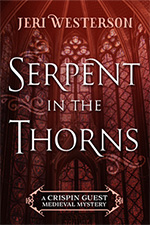
SERPENT IN THE THORNS, The Second Crispin Guest Medieval Noir, in bookstores.

INTRODUCTION

In 1384, a simple-minded tavern girl comes to Crispin’s door—a body was found in her room and she’s the only person who could have killed him. Except for the fact that the man was killed by a precisely aimed arrow. Making matters worse, the murdered man was one of three couriers from the French king, transporting an important relic intended to smooth the troubled relations between France and England. Events quickly spin out of control and Crispin now finds himself the prime suspect in the murder, one with grave diplomatic implications. As the drumbeat of war between the two countries grow, Crispin must unravel the conspiracy behind the murder to save not only his country, but himself as well.

 BOOK DISCUSSION GUIDE

Cast of Characters

Crispin Guest, the Tracker
Jack Tucker, his servant
Gilbert and Eleanor Langton, owners of the Boar’s Tusk tavern
Simon Wynchecombe and John More, the sheriffs
William, his sergeant
Grayce, a scullion at the King’s Head
Livith, her sister
Ned, servant at the Boar’s Tusk
Gautier Le Breton, Laurent Lefevre, Michel Girard, French couriers
Miles Aleyn, Captain of the King’s Archers
Martin and Alice Kemp, the tinker and his wife
John of Gaunt, the duke of Lancaster
Brother Eric and Brother Michael, monks of Westminster Abbey
Abbot Nicholas de Litlyngtion, Abbot of Westminster Abbey
Lenny, thief
Edward Peale, the king’s fletcher
Onslow Blunt, the king’s cook
Freddy, scullion in Onslow’s kitchen
Peter and Wat, the king’s archers
Richard II, the king

QUESTIONS FOR DISCUSSION

1.  Why does Grayce come to Crispin in the first place?

2.  Why does Crispin keep the Crown rather than surrendering it immediately?

3.  What power does the Crown seem to possess?

4. When Crispin discovers the true nature of the old Plot, is his reaction justified? Should Lancaster have told him the truth to begin with?

5. Why does Livith toy with Crispin?

6. Who were the most interesting characters?

7. How does Jack Tucker help Crispin?

8. What is the importance of religious relics to the people of the Middle Ages?

9.  Archery plays an important role. What was its importance to the fourteenth century, particularly?

10. John of Gaunt was a powerful man in his own right. Why did he settle for remaining duke rather than taking the throne for himself?

11. There is an homage/noir in-joke having to do with a character’s name. Have you figured it out? (Email me if you can’t)


Questions for Jeri Westerson on Serpent in the Thorns 

Tell us about your second book in the series, SERPENT IN THE THORNS.

Serpent has Crispin visited by a dim-witted tavern girl. She’s found a dead man in her room who turns out to be a French courier transporting a sacred relic from the court of France to the court of England. Is the relic a peace offering from the French king or part of an assassination plot against England’s King Richard? With time running out, Crispin must get to the truth before he falls prey to a deadly trap.

Serpent in the Thorns plays much more like a suspense novel than a mystery. It’s what I call my “ticking sundial” story.

Why do relics play such an important role in your series?

Religious relics are part of the cultural mindset of those in the Middle Ages. The Catholic faith was integral to everyday life in medieval Europe. Seasons and festivals have a religious base, or at least adopted a religious foundation swiped from England’s pagan past. Bells from churches and monasteries tolled the time of day. Indeed, the concept of timekeeping stemmed from the monastic need to pray the Divine Office, those special prayers that divided up the day. This was a time when there was no distinction between passing from the earthly plane to that of the spiritual, and relics were that tactile portal that bridged the gap between God and man. The relics of a saint, a holy person, or something that was close to Jesus, like the Crown of Thorns, was particularly prized. So much so that we have the beginnings of vacations, that is, pilgrimages to see holy sites or holy shrines containing a saint’s relics, either an actual portion of a saint like his or her bones or hair, or something that touched them, like cloth or something they used, like a cup.

As far as the stories themselves, there was the idea of a McGuffin, an object that propels the plot, either something everyone is trying to get their hands on or can’t wait to get rid of. I wanted another element to these character-driven stories besides a murder and whodunit. But I didn’t want to get too formulaic about it either. I don’t think that’s very interesting for readers and I sure as heck don’t find it very interesting to write. For instance, there are already the tropes from hard-boiled fiction: the sheriff as the mistrusting police lieutenant; the women and femme fatales who inhabit the stories; Crispin’s wise-cracking. I didn’t want the books to devolve into “Crispin finds a relic that has to do with the murder.” Instead, the relic is a foil. Sometimes they have everything to do with the plot and sometimes they are merely periphery. By the same token, sometimes the murder is the main story, and sometimes the main story is really something else, with the murder as a red herring. I find this a far more interesting approach to a story I’m writing as well as one I might be reading.   

Do you believe in the mystical nature of relics?

I know that people still believe in their spiritual properties. There are many faithful who still flock to miracle sites and line up in churches to see venerated objects. People are attracted to the idea of objects and people with some attachment to God. I don’t particularly believe in objects possessing any sort of mystical power, but I still find the notion fascinating. And if I do, then I know others will be interested. 

What is so attractive about writing a character like Crispin Guest?

Crispin is so complex. There are many layers to him. First we have the lord and knight, the man he was raised to be with all its trappings. And he is a well-educated man and skilled in arms and action. That’s an attractive aspect to his personality. But now he is forced to rethink his past and his choices, even his position. He must live amongst people and befriend those he would never ordinarily have even talked to. This changes the dynamic of his own perception of himself, forces him to face his prejudices and to question their validity. Will he be the same man in book twenty that he is in book two? I hope not. He will have learned and experienced a great deal by then.

And lastly, I enjoy exploring the masculine perspective, that unique outlook on life that a medieval man—hell, a man of any time period!—experiences. How does he react to certain circumstances? Is it strictly the opposite of how I would react, and if so, why? These are all a part of getting into the head of one’s character and it makes writing him particularly exciting at every turn.              

You mentioned a book twenty. But is there a book three?

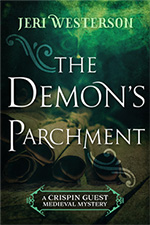
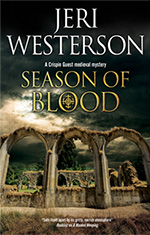
Oh yes! In fact, there is a book three and four! I signed with St. Martin’s for two more Crispin novels, which are already written. Currently I’m working on book five, tentatively titled SEASON OF BLOOD. Book three is called THE DEMON’S PARCHMENT and it’s about a serial killer on the streets of London: Jacob of Provencal is a Jewish physician at the King’s court, even though all Jews were expelled from England nearly a century before. Jacob wants Crispin to find stolen parchments that might be behind the recent, ongoing, gruesome murders of young boys, parchments that someone might have used to bring forth a demon which now stalks the streets and alleys of London.

I’ve already got a few reviews for The Demon’s Parchment:

“Westerson’s third novel is a compelling read. Her illustration of issues that still simmer today is nuanced and sensitive, her characters will surprise and delight you, and her elegant prose will lure you in from the start. With The Demon’s Parchment, Westerson is at the top of her game.” –Libby Fischer Hellmann, author of Doubleback; A Suspense Novel.

“The Demon’s Parchment is so good it’s sinful.  With an unerring eye to historical detail and an uncanny knack for making the distant past feel comfortably contemporary, Jeri Westerson has written a novel sure please even the most demanding reader.  Protagonist Crispin Guest (a.k.a., The Tracker) is seductive as hell, and the writing is some of the best you’ll find anywhere.  Buy this book or be damned!” William Kent Krueger, Anthony-Award winning author of Heaven’s Keep

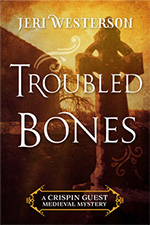
Look for THE DEMON’S PARCHMENT to be released in the fall of 2010, and book four, called TROUBLED BONES, in 2011.