Back in the days when I was a kid in school, I was more or less the token Jew. So every year I was asked by grade school teachers to give a presentation of the meaning of Hanukkah. And I was only too glad to do it, because I was a little weary of the well-meaning wishes from even the teachers that exhorted me to celebrate my “Jewish Christmas.” It is not. Most definitely.
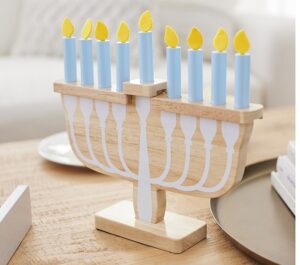
I brought with me a tiny menorah, that eight-branched candelabra, one small enough to use birthday candles in (you might have noticed NINE candles in a menorah. The center candle is the shamash, the helper candle that lights all the other candles. Interestingly enough, Shamash is an ancient Mesopotamian Sun God representing truth and justice, giver of light. A Hebrew Shamash is a sexton or caretaker (servant) in a temple. And, one more, a Shamus, deriving from the Hebrew Shamash and Irish Seamus (meaning servant) is also slang for a detective).

I explained to my fellow classmates that each candle represented a day, and each day a miracle. That God allowed that the oil that was only enough to burn for one day miraculously burned for eight days in order to consecrate the Temple. I went on about the Maccabee brothers, showed how to play Dreidel, even led them in song with “Hanukkah, O Hanukkah.” You know the one. It goes like this:
Hanukkah, O Hanukkah, come light the Menorah,
Let’s have a party; we’ll all dance the hora.
Gather round the table, we’ll all have a treat
Sivivon to play with, and levivot to eat.
And while we…are playing
The candles are burning low.
One for each night, they shed their sweet light,
To remind us of days long ago-o-o-o.
One for each night, they shed their sweet light,
To remind us of days long ago.
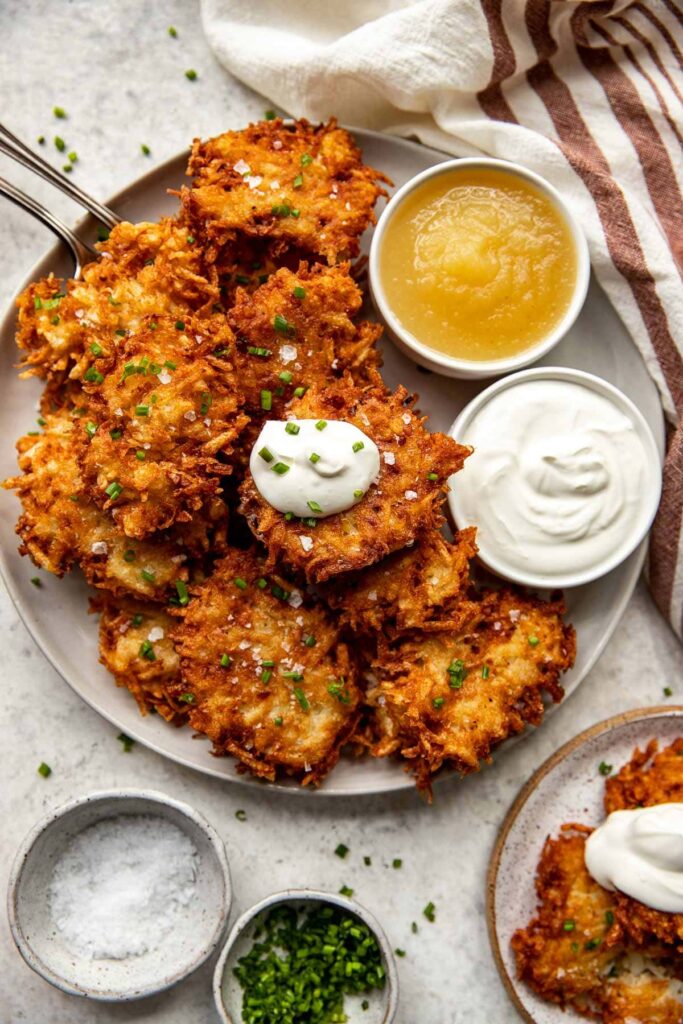
Sivivon are dreidels and levivot are potato pancakes (served with applesauce and sour cream in the Ashkenazi (eastern European) tradition (and they are dang good!)
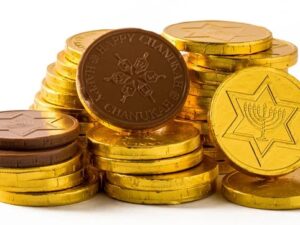
My audience of grade schoolers were vaguely interested in these proceedings…until I mentioned that we got presents for EIGHT DAYS! Heads perked up. But don’t get excited. These were usually small gifts, chocolate money or real money called Hanukkah Gelt (that’s Yiddish for Hanukkah money) and little toys.
Gift giving was very recent in terms of the timeline. It was more in response to the gentile neighbors giving gifts for Christmas as Hanukkah usually falls near Christmas, though the date changes. It can be as early as November and as late as the very end of December. That’s because Jews follow the lunar calendar which tracks the phases of the moon and all the feasts and holidays are moveable (ever wonder why Easter moves around? It has to follow Passover, right? Be kind of silly if it didn’t.)
So what’s behind Hanukkah, anyway? Hanukkah, or the Dedicating of the Temple, or the Festival of Lights, comes from something called the Megillit Antiochus or the Scroll of Antioch, dating from somewhere between the 2nd and 5th centuries CE. The Books of Maccabees talks about a re-dedication of the Temple by Judah Maccabee, his brothers, and his army, but never specifically mentions a miracle, only that the celebration should last for eight days, which, indeed, most Jewish holidays do. (In Jewish numerology, Seven is the perfect number: seven days of creation, seven days of the week. But the number eight–God–is beyond perfect. Eight days old a boy is circumcised and brought into the covenant. Eight days for many Jewish celebrations.) It is this scroll that gives us the story of the miracle of the oil.
The Story: Around 175 BCE, Antiochus IV Epiphanes King of Greek Syria and other places, ruled over the Jews and outlawed Judaism, ordering a statue of Zeus to be erected in the temple. Not nice. Having a graven image in the temple desecrated it. The Maccabees revolted, won, and worked to re-consecrate the Temple, getting all that nasty gentile stuff out of there, building a new altar, etc. In order for the re-dedication to be complete, the menorah or candelabrum or multi-burning oil lamps were to burn for seven nights, but there was only enough consecrated oil to burn for one day and there was no time to get more. But it miraculously burned for eight days. Thus the eight-day celebration.
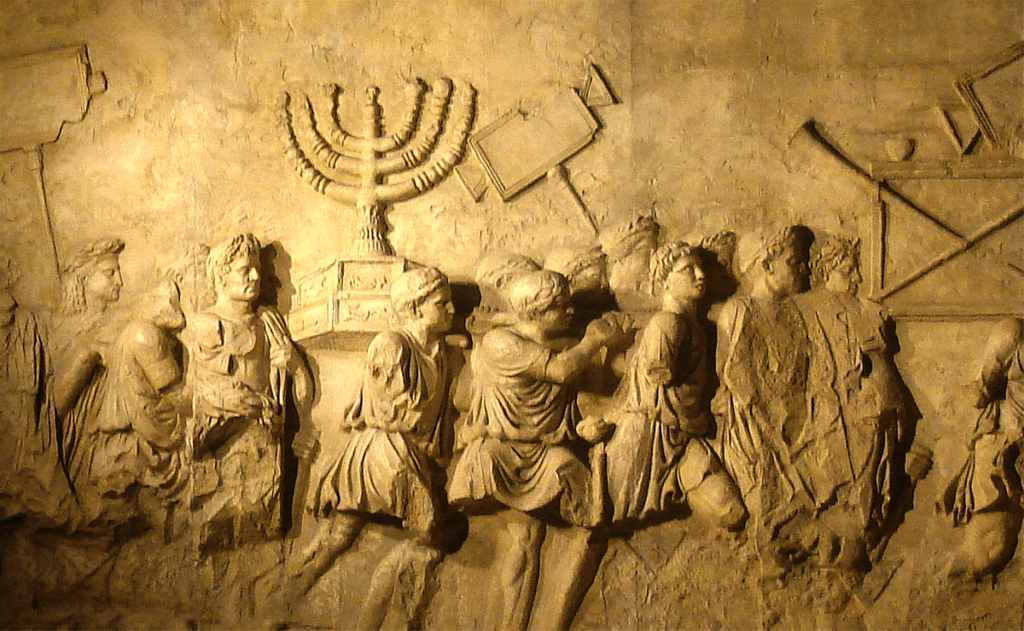
It’s funny, because I just began wondering if temple members kept secretly bringing in oil to help with the dedication, not wishing to be identified, and then someone yelled, ‘’It’s a miracle!’’ and they were all too embarrassed to come forward. Thus, are holidays born.
In the Middle Ages, the Megillit Antiochus was read aloud in synagogues, a rabbinically declared holiday and a tale about Jews rising up against their oppressors. As you can imagine, such stories were pretty popular amongst Jews in the Middle Ages where they were always being oppressed and forced to leave country after country. Jews reenacted the lighting of a menorah in the synagogues as well as in their homes. The proper way to light a menorah is to keep it in a doorway. Not quite practical, especially with long, trailing robes, so the next best thing is to have it in a window, fulfilling the rabbis decree to show the miracle to the world (which is why there are all those public displays of menorah lighting. It is NOT the Jewish answer to a public lighting of a Christmas tree. If anything, it’s the other way around.)
Though for all that, Hanukkah was never a huge holiday. It was just one of many. Certainly not a High Holy Day like Rosh Hashanah (Jewish New Year) or Yom Kippur (Day of Atonement). It was another reminder to Jews of God’s miracles and His dedication to the Chosen People no matter where they found themselves and under what circumstances.
It is the Eastern European tradition of eating foods cooked in oil, foods such as latkes (potato pancakes) and donuts make it especially fun. Can’t knock that. Playing the dreidel, a top with Hebrew letters on each of the four sides, is supposed to be a reflection of a game that the Maccabees played while waiting to attack their enemies. It’s like dice. It’s a gambling game. And very, very old.
Wow. Sixty years later, I’m still explaining it.
So, a bit of old traditions blended with newer and plenty of good food. That’s what makes a holiday in any language.
Discover more from Jeri Westerson
Subscribe to get the latest posts sent to your email.
I am so impressed! What a great explanation. Thank you for sharing the story of the light of chanukah… bring light to a lot of darkness.
It was just part of life. Though I am an atheist, I still like the traditions and culture, so I still have it. Not too far from the Christmas tree (hubby isn’t Jewish).
Great explanation and congratulations on over 60 years of telling the story, educating the gentiles.
Tee hee!