The London I write about in my mysteries is never the London you can see today. Not my Crispin Guest Medieval Noir London set in the fourteenth century. Nor my Tudor London set during the reign of Henry VIII in the early sixteenth century for my King’s Fool Mysteries. Structures and city walls are long gone. Palaces have fallen to ruin or remodeled so much as to be indistinguishable from their former royal magnificence.
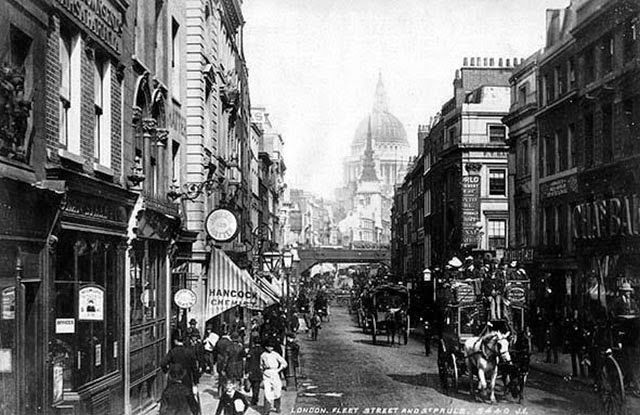
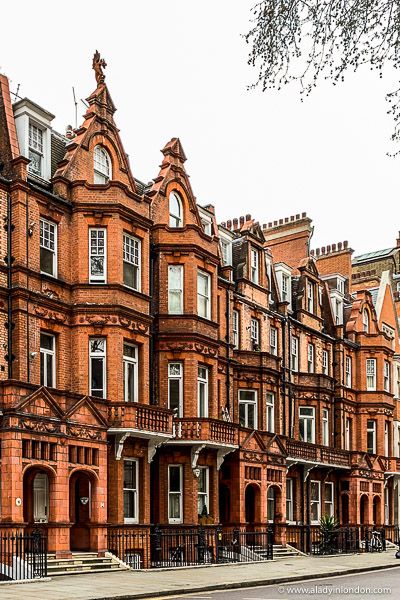
However, the London of the late nineteenth century, the London of Sherlock Holmes and Dr. Watson, is fairly intact. From the brick warehouses along the banks of the Thames, to Christopher Wren’s domed St Paul’s Cathedral, to some of the older railway stations, to rows of terraced housing, to even select Victorian pubs. That London remains.
And to a mystery writer, the idea of a London of murky streets is just the ticket. After all, the pea-soupers that they used to have in the nineteenth century hid Jack the Ripper as well as Mr. Hyde.
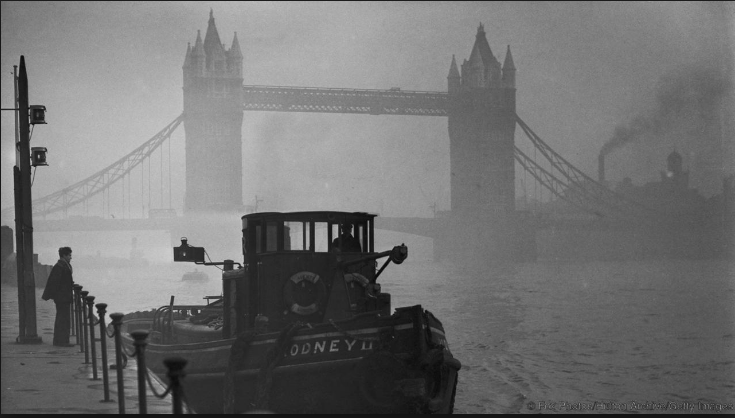
They were due to the coming of the Industrial Revolution where coal was king and chugged and puffed its way into the atmosphere from homes, factories, and railways. The smoke and dust of coal mixed with the fog that was already a hallmark along the Thames, thickened the fog to a deadly, opaque veil. The word for it was “smog”, a portmanteau of “smoke” and “fog” that was first coined not in the mid to late twentieth century as one might expect, but in the first years of it. Henry Antoine Des Voeux first mentioned it in his 1905 paper, “Fog and Smoke” that he presented to the Public Health Congress.
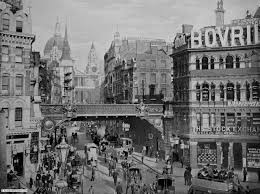
Traveling these streets in my mind that Sherlock Holmes himself traversed—or, I suppose, Doyle himself, its high places, its low places—adds realism to something that is historical to us, but contemporary to his first readers. I have a copy of the Reynolds Distance Map of London, With the Recent Improvements, 1891, a real map from the time period.
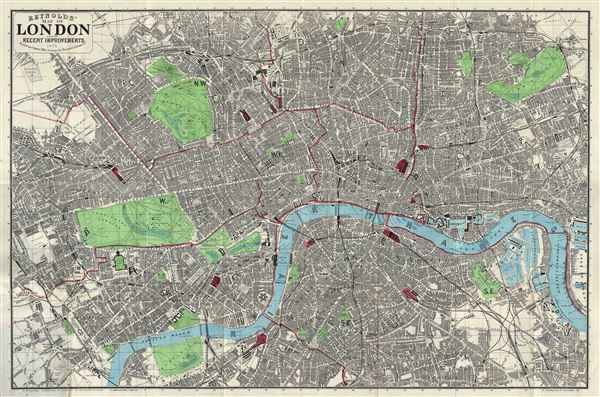
And so I am able to follow all the streets, railways, and omnibus lines to give them life to my readers of these Sherlockian tales of An Irregular Detective Mystery series which is mostly Sherlock adjacent. Not that Holmes doesn’t make an appearance now and again, but it isn’t focused on him. Instead, it concentrates on one of his former Baker Street Irregulars, Tim Badger, who aged out of the Irregulars and took up the mantle of private detective along with his colleague Ben Watson, a black bloke from Camden.
It’s real to me, so I make it as real as it can be for my readers.
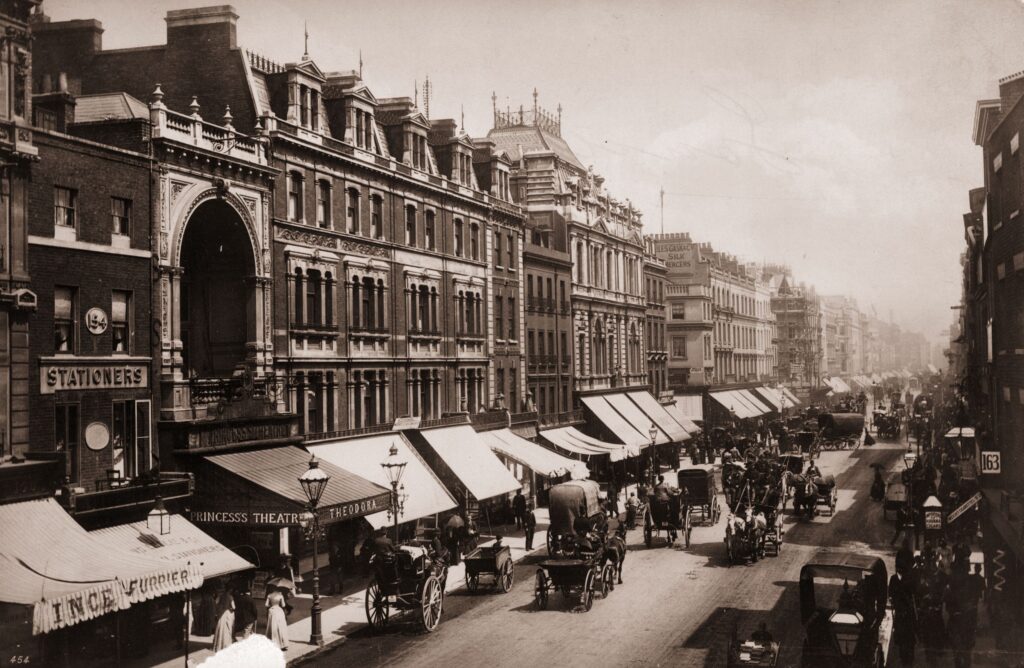
Life in London in 1895 was still traveled by foot or by horse, and the many different kinds of carriages and conveyances that horses pulled. Electricity was slowly coming into play, but the street lamps were still gas lit by lamplighters at dusk, and snuffed out in the morning. Telephones were in use, but only by the elite (and Holmes disdained them). The terrific noise that horse hooves, wagons, and hansom cabs made clattering along the streets must have been nearly intolerable. Add to that the shouts of costermongers (cart men) selling their wares, and public houses overflowing with loud and drunken patrons. The presence of bobbies with their tall custodian helmets and whistles on chains pinned to their chests were a common sight. Then there was the seamier streets with their opium dens and brothels or knocking shops as they called them. This was a teaming London, and little wonder it becomes a character of its own.
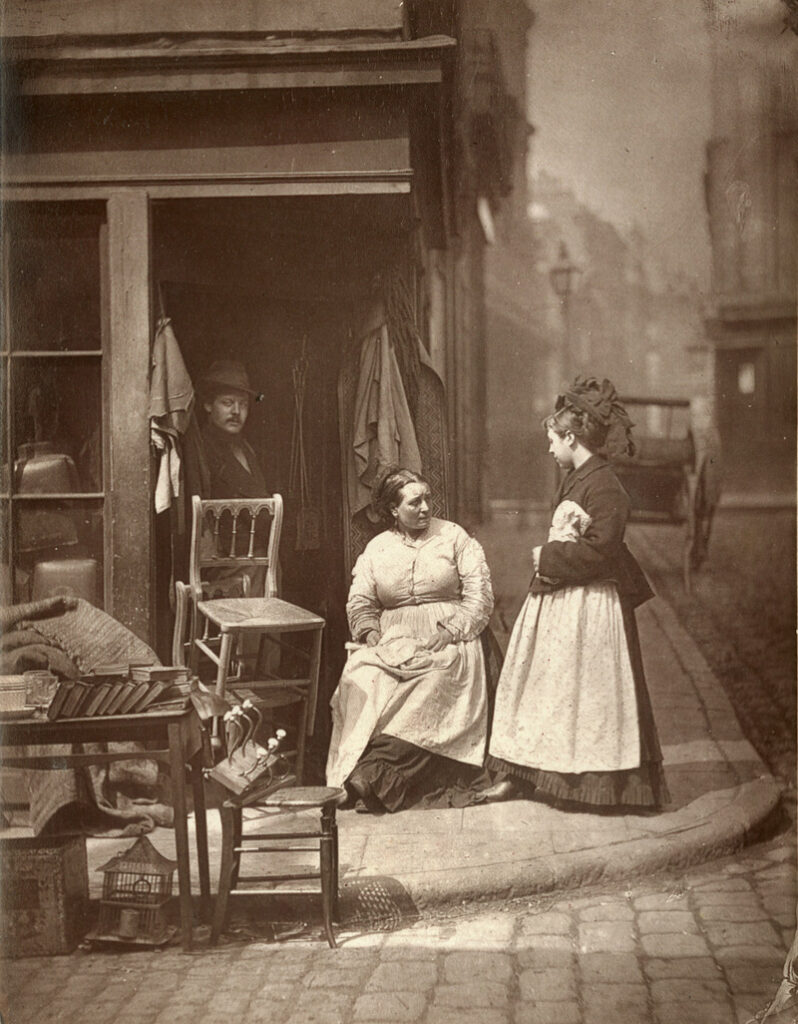
Still, there was the upside of that “modern era.” The post was delivered a staggering twelve times a day. There was the underground for getting about quickly without the traffic of horse-drawn omnibuses. And there was even the first vegetarian restaurant in London in 1879, the Alpha Food Reform Restaurant on Oxford Street.
You got your news from a wide variety of newspapers, some right-leaning, some left-leaning. They arrived at your door, some even three times a day; in the morning, afternoon, and evening.
And then there were the railways, sending out arteries from the heart of London to all four points of the compass, making the capital city the true pulse of the slowly modernizing nation.
All of this and more is merely the background to the story. We think of world-building as something for fantasy alone, but the past needs to be brought to life just as much as fictional worlds. It’s knowing all of this and using it not against your characters, but as the life they take for granted. How the different levels of society navigate their world, how my characters learn and grow to be the detectives that Holmes mentored them to be. This is what paints a three-dimensional picture for the reader. And of course these surroundings inform who the characters are and how they approach their detecting and understanding of the criminals they encounter, whether those culprits are in the halls of government or the lowest pickpocket on the streets.
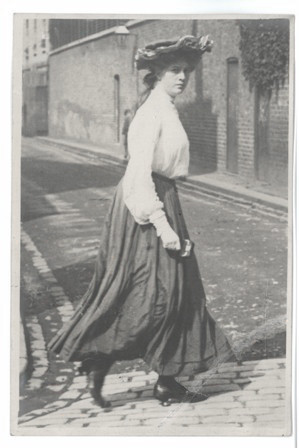
But besides all of that, a Sherlockian pastiche must also include a knowledge of Doyle’s canon of the Sherlock Holmes tales, and, for me, it is only those written before and during 1895 when my current books are set. Because for these books, the canon is just as sacrosanct as the history. I try my best not to deviate from what we know of Holmes and Watson and their cases. Holmes has no added wife, sister, daughter or son. He is who he will always be in canon, as is Dr. Watson. And when I write my own characters who walk through the different eras of history, they are as real and true to their time as if they truly could have existed. That’s the challenge of writing historically and the extra challenge of taking on a mystery as well as a pastiche of another author’s classic works.
Discover more from Jeri Westerson
Subscribe to get the latest posts sent to your email.
I love historical mysteries. Those are the only ones I read. 👍🏻
Then isn’t that lucky that I write them. I love my readers. They are my kind of people.