Many of us think of the Victorian period of genteel people dressed to the nines — men in their starched collars and fitted suits, mustaches, perhaps even side whiskers, parted pomaded hair…and women in their corseted bodices, voluminous skirts, and bountiful, coifed hair — sitting in their drawing rooms with tea cups in hand and dining on cakes and scones.
But underneath that staid exterior lurked a people who loved their crime stories, the bloodier, the better. And it didn’t start with Jack the Ripper. But much, much earlier.
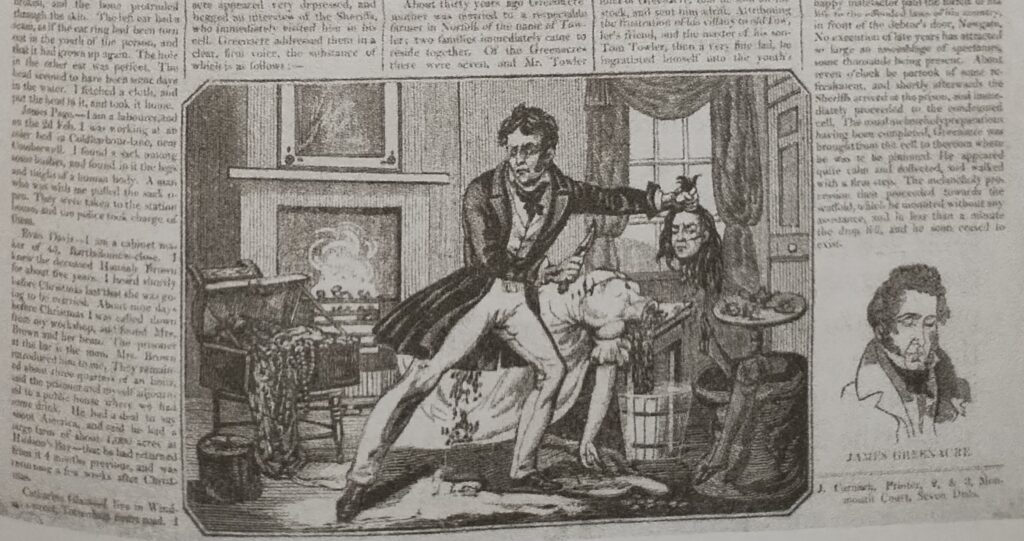
Of course, this purience isn’t exclusive to Victorians, or the British. Humanity has always been entertained by violence perpetrated on others. “There but for the grace of God go I” has perhaps been humanity’s banner. From Aztec rituals (some say voluntary), to throwing Christians to the lions, to gladiatorial combat, to the Crusades, to the guillotined nobility in 18th century France, to the firehosing of African American protestors, and on and on, even to today, with MAGAs enjoying the brutality of ICE. Humanity has yet to grow out of their thirst for violence.
But today, we are looking back at the early Victorian thirst for all things criminal, and it seemed to begin somewhat with widely distributed broadsides and pamphlets in the 1820s.
A particularly brutal murder was splashed all over the papers. One was the murder of Maria Marten by William Corder in Polstead, Suffolk, also popularly called The Murder in the Red Barn. Corder and Marten eloped and her parents hadn’t heard from her in some eleven months. As the story goes, Corder and Maria had an argument and he lured her to the red barn about a half a mile away from Maria’s parents cottage, where that argument turned to murder most foul. She was then concealed in that same barn and wasn’t discovered for eleven months (one has to wonder that the smell wasn’t a tip off). It was said her mother had dreamed several times that Maria had been murdered and was buried in the barn. There’s a lot more to the story, which you may wish to read here.
He was tried, found guilty, and the judge, who was with the jury and the audience all the way, said, “My advice to you is, not to flatter yourself with the slightest hope of mercy on earth …” and then sentenced him to die by hanging and then dissection, which they did after leaving his lifeless body hanging for some hours, cut him down, and took him into a doctor’s surgery where the doc peeled back the skin of his chest to leave it exposed and let the public in to view it. Keen, huh?
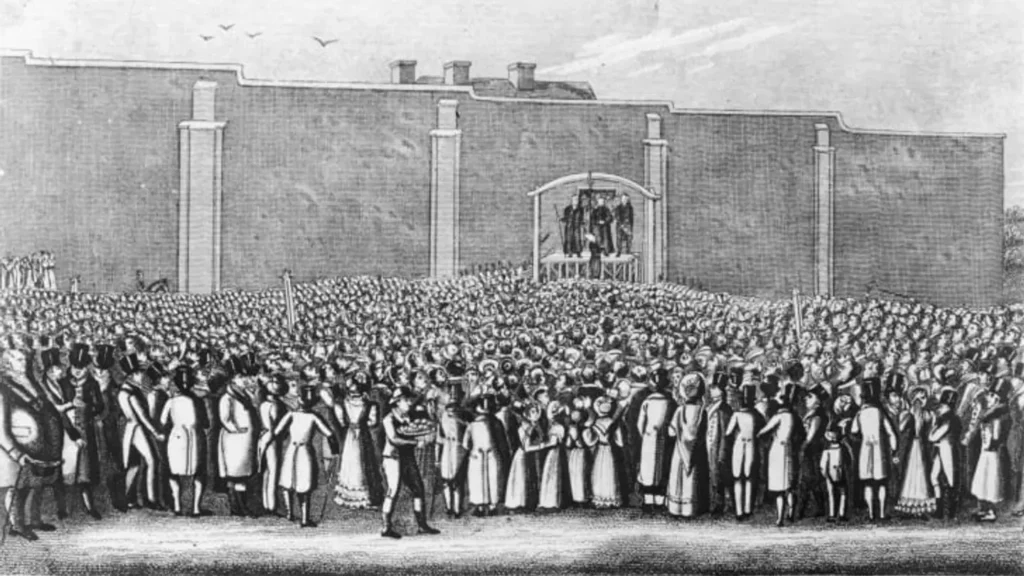
It was said 7,000 spectators came to his execution.
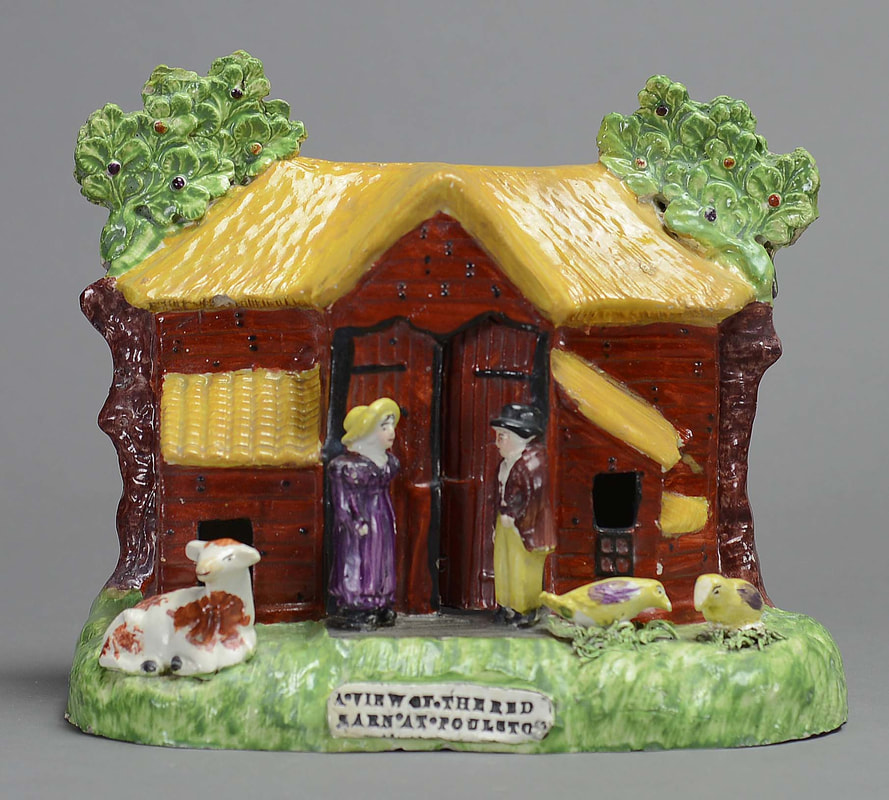
But that was certainly not the end of it. With a trial, tourists flocked to the red barn in question to see where the murder took place, and to take souvenirs away. The entrepreneurial even made creamware to sell of a mug of the murderer’s image, earthenware figurines of the murderer and the victim, and one even of the red barn itself with the victim and murderer with the pastoral image of flowers and trees around the barn, with a gentle cow and chickens alongside it.
The more respectable folk distanced themselves appropriately from the hoi polloi in this vicious interest in the murderers and victims, though they kept abreast of the trials and subsequent executions of the criminal class. But the new broadsheets (what we would call tabloids) really went to town and the working class slurped it up in all its bloody detail.
It’s the violence that mattered. When Richard Gould and Mary Ann Jarvis were captured for murdering John Templeton in 1840, the murder — as seen through the eyes of the charwoman, was put to verse:
She gave the alarm, the door was forc’d/And then all stood aghast/ In a pool of crimson gore he lay/ And his hands were tied fast/ His skull was near to atoms dash’d/A bloody stocking round his head/His teeth were scattered on the floor/ And his blood had dyed the bed…
It goes on and on. I’ll spare you. It’s not great poetry but does the job. There were a lot of these, sometimes from the point of view of the murderer themselves, with sometimes a moral warning to others not to fall into these violent ways:
Now all young men that hear these lines/Pray think upon my sad state/Reflect upon your evil ways/Before it is too late…
Perhaps the editors of these broadsheets thought they could justify their printing the lurid illustrations with bits of poetry. Can we also put it down to “the style at the time”?
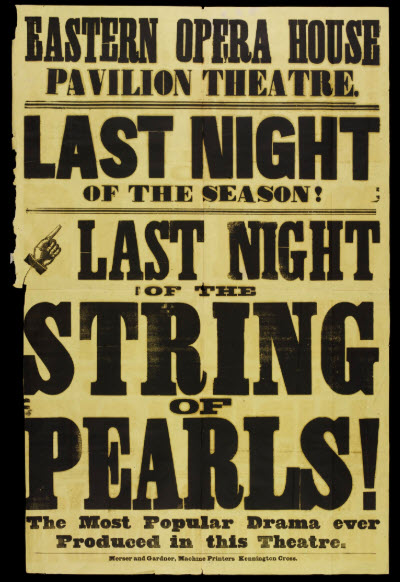
And then there were the plays put on to either re-enact more famous murders, including the long-running theatre of “Maria Marten; or The Murder in the Red Barn”, or to perform fictitious murders. One of the melodramas of pure fiction was first called “String of Pearls”, but you might know it better as “Sweeny Todd, the Demon Barber of Fleet Street”.
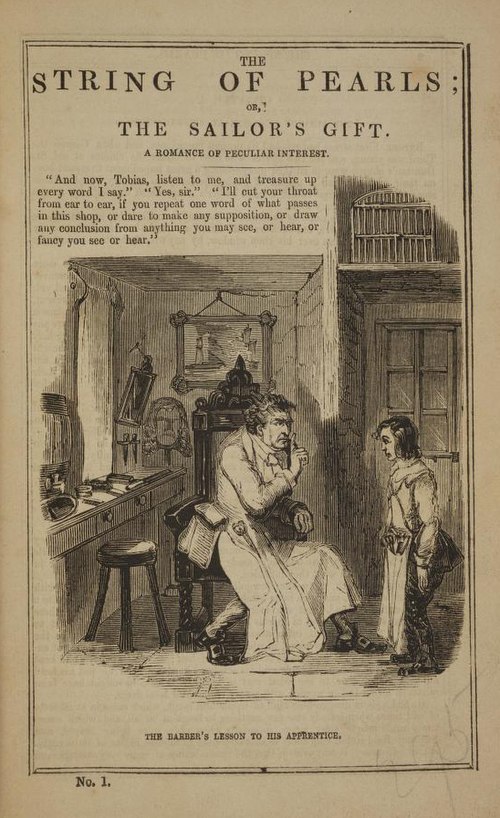
The above is the Penny Dreadful, and below is the playbill.
At this point, fact from fiction barely mattered when sitting in your theatre seat. It could have been real, and that was really all that mattered. It started life as a penny dreadful, but soon found a new audience in the theatre in the 1840s (ever before Steven Sondheim made it into a musical). You all know the story, right? Set in 1785, a barber in Fleet Street kills his clients (one hopes after they’ve paid) and sends the bodies to his partner in crime through an underground tunnel to Mrs. Lovett who bakes them into pies which she sells to the public. Just your average story.
This, of course, is long before the most famous killer of all, Jack the Ripper makes his appearance in the White Chapel area of London in the late Victorian period.
And I guess those of us who write mysteries rely on readers who love a good mystery that usually involves a murder. Do we like mysteries because of the death and lurid details? I’d like to think that it isn’t so much that (because I don’t like to write the lurid details or gore of the murders). I think it’s more about the satisfaction of the murder being solved, of justice coming out of community disarray, that right triumphs over might. At least, that’s the perspective I like to think about it. And though there is a puzzle (which readers really enjoy), it is usually about a murder, because that is the ultimate crime. You can’t come back from that.
But you can write about it, whether it happens to be fact or fiction.
Discover more from Jeri Westerson
Subscribe to get the latest posts sent to your email.
I completely agree about the satisfaction of the murder being solved (and justice being done in the end). It’s why I avoid true crime in favor of fiction. I especially hate it when the perpetrator is never caught. Thank you for giving us many great endings that lets me sleep at night!
It helps ME sleep at night too. I do like happy endings, even if there are some pretty dramatic things happening in the novel.