If there is but one idea that I can leave you with if you are ever considering self-publishing, it is this: You’ve got nothing but time!
The biggest mistake of any self-publisher is their rush to publish. Type “The End” and then hit that “publish” button. Huge mistake. After all, why is it you want to self-publish? In a hurry to rake in all that dough? Please. I think you and I both know that is not going to happen, at least not without a lot of careful thought first. If it’s a career you’re after, then you’ll need to be a professional about it and learn all the details of what it means to be not only an author, but also a publisher.
With a slew of things to be done, making a list is the first order of business. I love making lists, setting goals. It helps me get my game plan in motion. And it was a good thing I did when I first self-published a prequel to my medieval mystery series. There was a lot to tackle.
Let’s back up a bit. I had published six books in my Crispin Guest Medieval Noir novels with St. Martin’s Minotaur Books before they dropped the series. I, however, was far from done with my medieval detective. And so while my agent sought another publisher for future books, I didn’t want a year to go by without a Crispin book on the store shelves. The actual first book in the series had been rejected by publishers years ago, including St. Martin’s, and it had been put to bed into a drawer. But I had always liked that novel. And besides, it was the origin story for my disgraced knight’s cutpurse-cum-servant Jack Tucker and I thought fans would like to see that. Calling it a “prequel” took it out of the volume numbering and wouldn’t interfere with whatever the next publisher wanted to do, so it was the best of both worlds.
I began my list thusly:
Check my contract
Many of us have one of the most idiotic clauses in any contract; the non-compete clause. Basically, I couldn’t publish another book of any kind within six months of my last Minotaur release. It’s idiotic because readers who like what you write won’t simply buy one thing you’ve written. They will likely buy ALL that you’ve written. But that was fine. The last release from Minotaur was November of 2013, so that meant I couldn’t release another book until May of 2014. So I set a random release date of July 2014, giving myself plenty of time. I knew I would need that time for rewrites, edits, and a host of other things.
Part of those “other things” was the next thing on my list:
Cover design
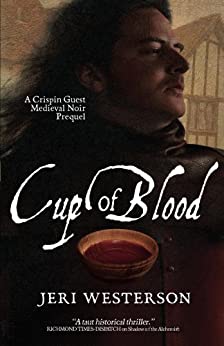
I’d need a cover for all the promotional materials I would send out—bookmarks, postcards, online banners—and for the arcs. I wanted to ship arcs to as many reviewers as I could afford (back in those days, you couldn’t send ebooks. Now the majority will accept them). I wanted the book to look as professional as possible so there would be no mistaking what a reviewer had in their hands. Another fortunate happenstance was that in my former career I was a graphic designer and art director, so design wasn’t an issue. I wanted a model on the cover just as the Minotaur covers had. My new cover would not copy but be reminiscent of the old covers so that the new release would fit with the rest of the series. Fortunately again, my husband is a commercial photographer, the model was a friend of ours, so all the cover would cost me was a costume and a thank you dinner.
Which segues to the next thing on the list:
Budget
Not everything was going to be free. In fact, some things were coming up that would cost me a good chunk of change. Editorial work, for one. Costs of the books themselves, for another. Ads. Would I need to pay for formatting, ISBNs, bar codes? (Yes) And what platform would I ultimately go with? CreateSpace (what Amazon KDP used to be called)? LightningSource? IngramSpark?
Research takes time, including looking at what others were saying about these platforms, both pros and cons.
Hybrid author and former president of Sisters in Crime Los Angeles, Diane Vallere, looked at the differing platforms for her self-pubbed series that has long since found a publisher, and decided to go with as many platforms as she could. “As a consumer, I appreciate selection and buying choices,” she told me through an email interview. She didn’t regret being exclusive to one platform and in fact expanded to include KDP for paperback fulfillment through Amazon. “Though I still use LightningSource for bookstore and library fulfillment,” she added. There are now numerous platforms for print, like the above and now Draft2Digital, Lulu, and others. For ebooks, there are far more platforms for distribution now. Including Barnes & Noble for both.
After looking at my budget, which was pretty small, and at the ease of getting it all going, I chose KDP. If I went with them for my print exclusively, they would give me an ISBN (International Standard Book Number, it identifies your book and the publisher) and a bar code for free, a savings of some $300. However, it should be noted and, according to Angela Bole, executive director of the Independent Book Publishers Association (IBPA) when I heard her speak at a writer’s conference, the ISBN owner is the publisher. So surrendering that to KDP makes them the publisher, not you. And even though it’s free, YOU DO NOT WANT A PLATFORM TO BE YOUR PUBLISHER. As Vallere pointed out, you can come in with your own ISBN and simply let Amazon do their own fulfillment to their customers. And you can get TEN ISBNs from Bowker (the exclusive issuing agent for International Standard Book Numbers for the U.S.) for $295, cheaper than buying them one at a time (and you MUST have a separate ISBN for each platform for your print book. It gets complicated but if someone orders the book based on the ISBN, they won’t know which platform to pay to). KDP also offered a free template for Word so I could transition my manuscript into an acceptable and pleasing print format for the book’s interior, another cost savings. Which I still use (and it’s different every time based on page count) but, as time went on, I got my own formatter to fix my print glitches and create epubs for ebooks.
As user-friendly as KDP is, it didn’t solve some of the upcoming issues. For one, once I had formatted the interior and my cover (and it took some time to jigger it so that the spine art was correct), I would only be allowed to order five proof copies at a time. I had budgeted myself to send out thirty arcs for reviewers, including Publishers Weekly, Library Journal, Booklist (it should be noted that at the time, these publications had no self-publishing arm, so they accepted my manuscripts and did reviews of them simply by virtue of my having been reviewed by them before with St. Martin’s, my former publisher. And I sure didn’t mention I was self-publishing it. But now, they do have a self-publishing arm that you usually have to pay for, so I definitely don’t pay. Booklist and Library Journal still accept books for review, free of charge. And they matter because they are for libraries, an important sale). I also sent out a slew to newspaper reviewers, bloggers, librarians, and booksellers. How it worked with KDP is that you order the five allotted, re-upload the cover, let them okay it after some 24 hours for a reset, and then order five more. I begged and I pleaded, but they wouldn’t change this format unless I hit that “publish” button. This took a while as you can imagine, and paying shipping costs each time. A Smarter Me might have just forked over the money and then gone to LightningSource or Lulu to create arcs. But Smarter Me wasn’t on board at the time. They have since changed that policy.
The other aspect of having “nothing but time” was this book reviewer process. Industry magazine and newspaper reviewers (if you can find the latter anymore) insist on getting their review copies at least four to six months ahead of release. So if you want to be reviewed by the leading industry magazines—and you do—you will have to sit on your release for at least four months anyway.
A word about distribution and wholesalers. KDP offered what they called “distribution” through Baker & Taylor. Baker & Taylor (which as of this writing is out of business) and Ingram are not distributors. They are wholesalers that have book inventory in their warehouses. If a bookseller or a library would like to order your books and they have an account with one or the other or both, they go to them and order the books. Ingram will take returns from booksellers who can’t move those books off their shelves. Baker & Taylor doesn’t. Most booksellers naturally go for Ingram. Libraries used to use Baker & Taylor, and switched to another platform now. If you go with Ingram Spark, for instance for your platform, even though Ingram will carry your book in their warehouse and they will take returns from booksellers, it still doesn’t guarantee a bookseller will stock it. And remember, since you are the publisher, you pay all costs for return shipping and stocking.
According to KDP, Baker & Taylor took six weeks to list your book on their roll but that was only when you finally hit the “publish” button. But once you hit that button, that becomes the release. Foolishly thinking bookstores and libraries would be clamoring to get my books on their shelves, and knowing it wouldn’t even be listed with B&T until I hit “publish,” I felt I had no alternative but to secretly release the book two months prior to the release date I was advertising. So my July release is listed on Amazon as a May release. And in the end, it was all for nought, because even independent bookstores friendly to me—even the one where I always had my launches—insisted, as a matter of policy, on having the books on consignment rather than ordering them, so I had to order the truckload of books and bring them to the launch anyway.
The things you learn.
I learned other things. Like my books were usually released in the fall, but I speculated that a summer release might be good for all that vacation reading. What I hadn’t counted on was that a lot of folks who would normally have come to my launch were—you guessed it—on vacation. And so those numbers were a bit smaller than usual. And let’s face it, I’m only famous in my own mind, and because my book didn’t show up in any publisher’s catalogue, all sales were lower than usual from libraries and booksellers.
I also learned that though you are the creator and the book IS copyrighted the moment you create it, it isn’t fully protected. Oh, it’s protected from plagiarism (always keep ALL your working files), it does not confer on you the ability to receive punitive damages (like I and thousands of other authors are doing in our class action lawsuits against AI platforms that STOLE our books for AI training. For that, they must be registered with the U.S. Copyright office (yes, more money).
Is it worth it to self-publish? Is it a viable option? For me, it was a chance to get a book out there that I believed in during a period where nothing with my name on it was being published. It kept bloggers and industry magazines talking about the series. I had something new to sell when I made my library, literary luncheon, and convention appearances over the course of the year. That novel, CUP OF BLOOD, was also nominated for the Bruce Alexander Historical Mystery Award at Left Coast Crime 2015, and was a semi-finalist for the M.M. Bennets Award for Historical Fiction, so self-publishing definitely kept the series in the faces of readers. Then I self-published with my agent all of the ebooks for the first six in the series on Amazon UK when rights reverted to me. Then I had several other self-published books under my belt, new contracts for the rest of the Crispin series, and new contracts with advances for a few other genres.
But that was then. This is now. Now that I have ditched publishers completely, I’ve got my resources all figured out. I have my people for formatting, editing, I’m still designing my own covers and even adding some illustrations that I do (NOT Ai). I shall never make as much in the beginning (sadly, no advances) but in the long tail, it does add up.
I’m working on them all slowly, carefully. I know I have the time.
Discover more from Jeri Westerson
Subscribe to get the latest posts sent to your email.
I eagerly await every book you write, no matter how long it takes, good art takes time.
As a fan, I’m so happy you made it through all the challenges to get your books published!