Here is the second part of my take on only a few films set in the Victorian era. If you would like to see Part One, go Here. They are in ascending order from the Victorian year the films were set, rather than the year the movie was made. Let’s jump right in!
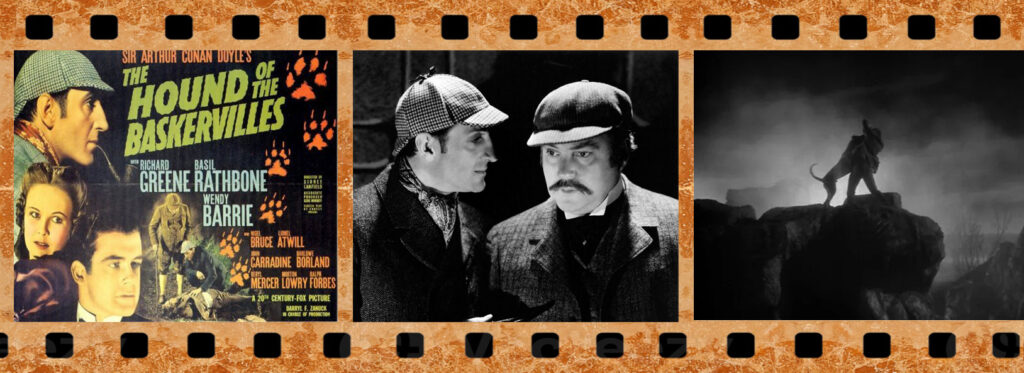
THE HOUND OF THE BASKERVILLES, 1939, set in 1889. A genuine classic. This was the first film in the Basil Rathbone franchise of Sherlock Holmes films. The first two (this one and the one after, both released in the same year, THE ADVENTURES OF SHERLOCK HOLMES (a remake of the stage play that William Gillette wrote with Doyle and performed in the lead on stage) are the only two with Basil Rathbone and Nigel Bruce set in the Victorian era from 20th Century Fox. They sold the rights to Universal which made them B films and set them in the modern era so Holmes could fight Nazis during WWII.
WHAT THEY GOT RIGHT: The casting. Basil Rathbone looks and sounds like what we expect Sherlock Holmes to be like. His erudite delivery, his prominent nose, are spot on. Even Nigel Bruce gets to play it straight in this one, as the intelligent Dr. Watson. The costumes are pretty good. And the gigantic hound attacks suitably scary. This series was the Sherlock Holmes of my childhood and I enjoyed them immensely.
WHAT THEY GOT WRONG: The women’s hair wasn’t great, and I will always mourn that the rest of the series didn’t stay in the Victorian era. Also, as the series went on after these first two outings from Fox, Nigel Bruce’s Doctor Watson was reduced to the typical role Nigel Bruce always played, the bumbling Watson, which was unforgivable, because it took a long time to get the REAL Watson, the intelligent doctor and former military man, back in vogue. Also, and this is always wrong in film, Holmes and Watson are supposed to be quite young. Much younger than their actor counterparts.
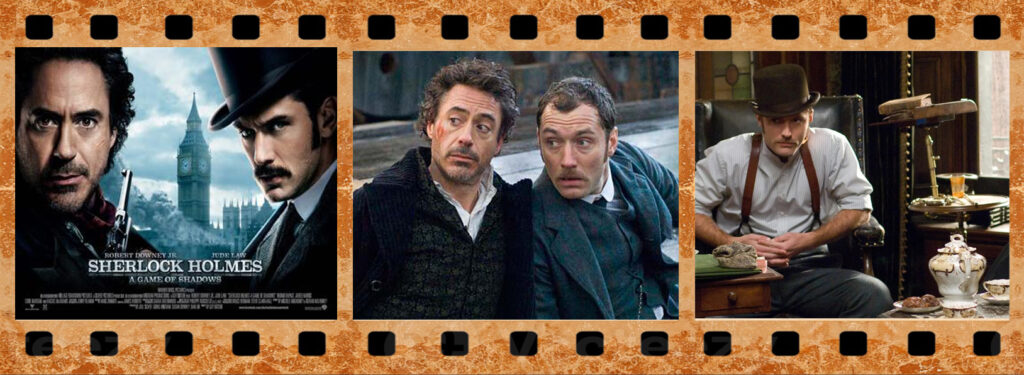
SHERLOCK HOLMES, 2009, set in 1890. Guy Ritchie got his hands on this fast-paced, quick edits of the Sherlock Holmes non-canon tale with some dubious casting and choices. It looks good, but looks can deceive. Full disclosure: I really liked this new take when it first came out. But as the years passed and with more viewings and more interest in canon Sherlock Holmes, I really began to detest it. It’s unfortunate, because he had the big budget to do a sterling job. The setting is good, the art and set direction fantastic, lighting, just right. Admittedly, it might have gotten younger audiences interested in Sherlock Holmes but setting them up for a fall when they sit down to read the original stories.
WHAT THEY GOT RIGHT: The setting of 1890’s London with all the grit of the East End of the city, with villainous villains. Jude Law was superb as an intelligent Watson and truly looked the part. (They are both supposed to be young!) I also liked that we got to see in quick-time how Holmes did his method of deduction. That was fun. And I don’t even mind the steampunky device that is at the heart of the mystery. But…
WHAT THEY GOT WRONG: Dear, dear me. It’s tough on a Sherlock Holmes film when you completely miscast the lead. Holmes is, in canon, tall, lean, cerebral. And though he does not keep a tidy flat, he keeps himself tidy and shaved as a proper Victorian gentleman would do at all times. Robert Downey Jr. is just not Sherlock Holmes, in stature, in physical appearance, and can’t quite grapple with a British accent. Guy Ritchie decides to make Holmes unkempt which is entirely wrong for the character. What was he thinking? Also miscast is Rachel McAdams as Irene Adler (if you must have her in a story. I realize this is all far from canon, but it wearies my mind to keep seeing her added in where she doesn’t belong). Her whole bearing, her face, her speech is far too modern. I cannot see her even in the era, let alone as Adler.
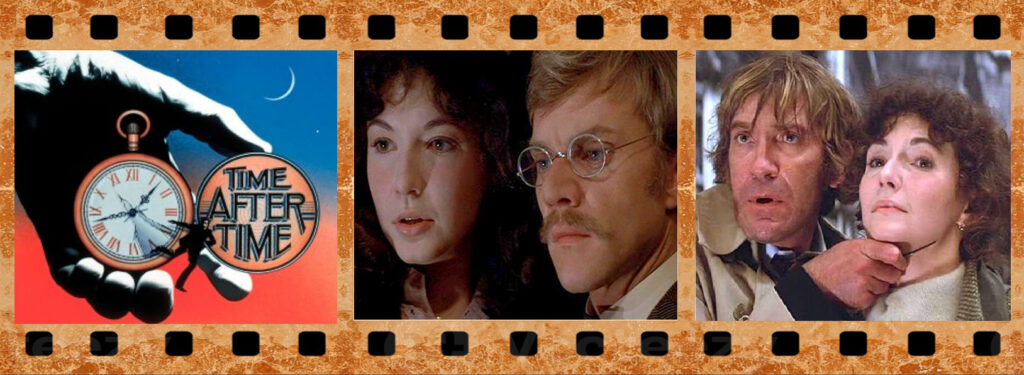
TIME AFTER TIME, 1979 set in 1893, then 1979. One of my favorite films of that year, written and directed by my fellow Sherlockian and Trekkie, Nicholas Meyer. What a clever story, the premise being; what if H.G. Wells really did build a time machine and he discovers that one of his best friends is really Jack the Ripper who steals his time machine to escape to wreak havoc in the future? Gosh, Malcolm McDowell was so cute. Yes, I had a huge crush. Lots of humor involved with Wells going after him and facing that brave new world that he could only have imagined. It’s a great adventure, still holds up today, too. Okay, so it’s the first part of the movie that is set in Victorian times and the majority of the film is in 1979 (which they got right! Heh.) And this hilarious note from Wikipedia: “While preparing to portray Wells, McDowell obtained a copy of a 78 rpm recording of Wells speaking. McDowell was ‘absolutely horrified’ to hear that Wells spoke in a high-pitched, squeaky voice with a pronounced Southeast London accent, which McDowell felt would have resulted in unintentional humor if he tried to mimic it for the film. He instead used a deeper, more ‘dignified’ accent for Wells.” You can hear the real H.G. Wells HERE. To be fair, older sound recordings tended to go too fast and therefore gave people higher voices.
WHAT THEY GOT RIGHT: Casting. You just couldn’t do better than Malcolm McDowell and David Warner. The latter is such a villainous villain. The Time Machine looks adequately Victorian and we get to learn a lot about the real Herbert George Wells in this. The chase is fun and tragic because Jack is up to his old tricks in the modern era. And the twist was great. It almost called for a sequel as to how Mary Steenburgen’s character fit in the Victorian era. I have a feeling not too well.
WHAT THEY GOT WRONG: It all worked so well, I didn’t see much wrong. Thoroughly enjoyable.
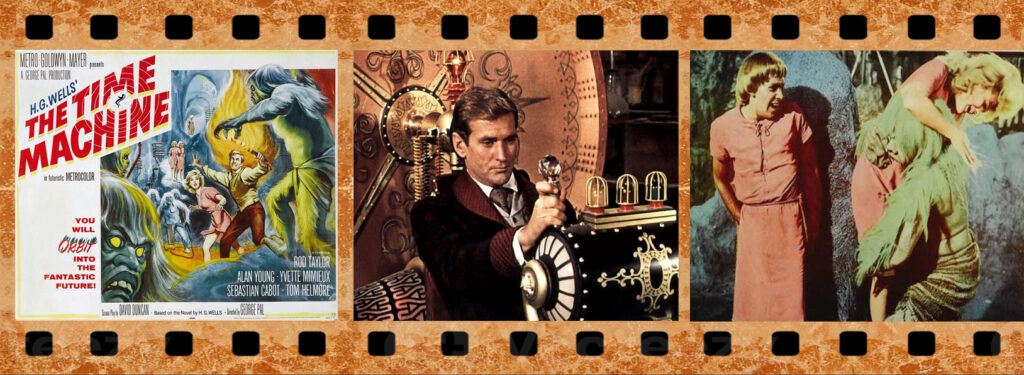
THE TIME MACHINE, 1960, set in 1895. Another take on H.G. Wells and his troublesome Time Machine, this time with Rod Taylor and George Pal directing. It’s from the book this time, of Wells’ Time Machine, with the well-meaning Wells building the machine and taking a trip into the future. What he finds is the Utopia he is looking for…but for whom? Well done special effects for the most part. We see what happens to London in a soupy volcano eruption of red-dyed oatmeal flowing through, following several nuclear explosions that in the script are called “mushrooms sprouting” as in mushroom clouds…that Wells didn’t yet know about. Entertaining for the whole family. Low budget Victorian setting, though, and with that 1960s television-style lighting. It took a while to find shadows again on TV shows.
WHAT THEY GOT RIGHT: The idea of H.G Wells and his optimism of the future, only to be crushed by the time he got back. The time machine itself in all its steampunky goodness. A fun story that takes you on an adventure, admittedly, out of the era. Of course, the lead has no name in the book, only being referred to as the “Time Traveler”. I suppose it’s too much for a writer to not make him Wells, but here they refer to him only as George.
WHAT THEY GOT WRONG: As with any futuristic story, they got the future wrong and the clothing. And we don’t see much of the Victorian era, just the blandest of accessories gotten off an old Gunsmoke episode, perhaps. It’s more about a Victorian man dealing with things he wasn’t prepared for, but coming through with valiant determination. The Morlocks are silly-looking but maybe they scared the bejeesus out of viewers back in 1960. That was the year I was born, so some older folks need to let me know how you felt about it. In the book, he does go directly to the very distant future, but here he makes some stops long enough to see wars in 1917, 1940, and a nuclear devastation of London. In 1960, the latter was on the minds of many people with the dawning of the nuclear age.
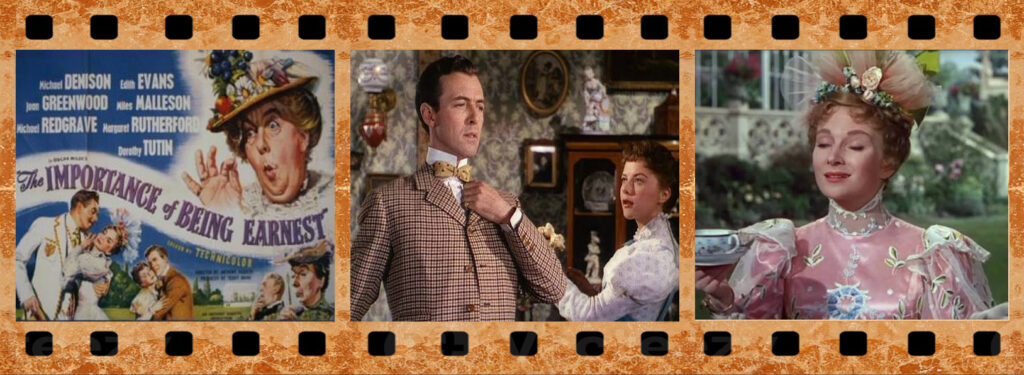
THE IMPORTANCE OF BEING EARNEST, 1952, set in 1895. A perfect ending to this blog post to have a film based on a play written by a Victorian man, Oscar Wilde. It’s a comedy on the mores of society and what was and was not acceptable. Needless to say, the dialogue was correct for the era. A play that many a high school had performed, being out of copyright, but the costumes would be expensive. It’s a witty play and so it is a very British production done in England with British actors and actresses. You couldn’t ask for more. The set design is accurate, as are the costumes and hair. Some my view it as stuffy, but once you get into it and really hear the lines, you will begin to be drawn in. Oscar Wilde is just one of those people you would have hoped to dine with…and apologize to for the treatment he got in his last years. He might be underappreciated now but he really was the toast of London and everywhere he went, including America. But it was still a don’t ask, don’t tell world, and he thought he could overcome that. It’s a painful history.
WHAT THEY GOT RIGHT: Well, you couldn’t ask for more, could you? A Victorian author, a British production. It’s spot on in every respect. For 1895, though, the women’s shoulders could have been poofier, but that’s a minor detail. This is the true flavor of the language and the clever repartee that one always dreams of but might not achieve as often as one wants to.
WHAT THEY GOT WRONG: The tone was correct. Everyone played it perfectly straight, no hamming or winking the witticisms. But as with most plays filmed on one or two sets, it is rather stagey. Let’s face it, it’s a talky play. When you are Oscar Wilde, you are going to write scads of dialogue. So they didn’t expand the action as they could have. But honestly, it’s still a minor infraction.
Well, that’s it. Yes, I could have done later adaptations. And yes, there are lots of films still out there to explore. But I kept to those that I have seen. And when it comes to faithful adaptations, I tend to go with the earlier ones, not the flashy newer ones. Style over substance doesn’t work for me. So yes, boy am I stodgy. But you might otherwise miss out if no one points them out to you. Keep those historicals coming, but for bacon’s sake, please get it right from casting, to costumes, to hairstyles, art and set direction. It’s so off-putting to have the wrong actor in the role. We want to enter that world for a little while.
Discover more from Jeri Westerson
Subscribe to get the latest posts sent to your email.
The Robert Downey Jr./Jude Law Sherlock film is atrocious. Robert’s accent was so bad that I couldn’t watch more than a few minutes of the film.
I adore the 1952 version of The Importance of Being Earnest. The dialogue was faithful and so witty. I recently rewatched the 90s remake with Colin Firth and it is dreadful. But the 1952 version is a delight.
I agree on all counts. Just because something is new doesn’t make it better.