I have a love/hate relationship with old films. I love old movies, and I love historical films, and I also hate them, because I know that the hairstyles and costumes will be wrong and it drives me crazy because it is just as easy to GET IT RIGHT. But there are some films that transcend, mostly because of the actors involved, the writers, and the directors. I will approach my very abbreviated list by the YEAR IT IS SET, NOT by the year the movie was made. Ready? Here we go!
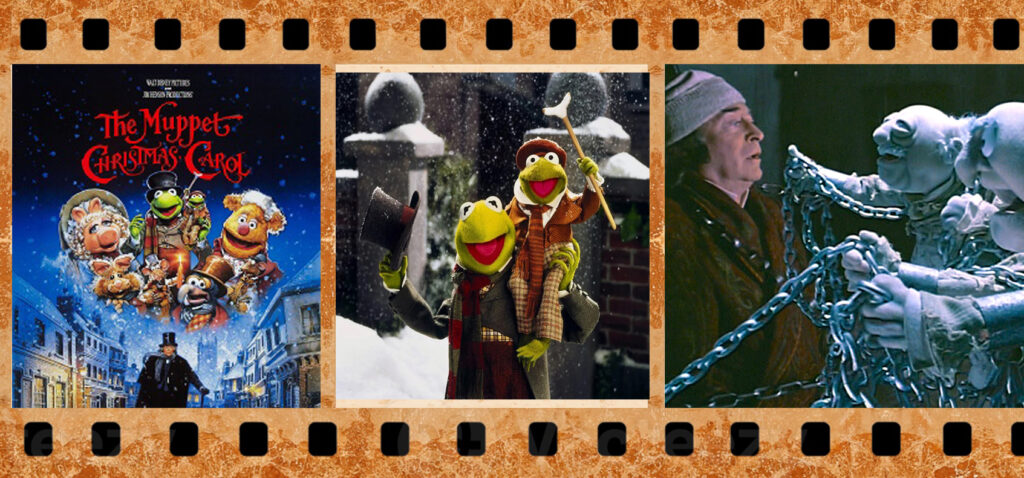
The MUPPET CHRISTMAS CAROL, 1992, set in 1843. Now, before you dismiss this, I really must tell you. As a Christmas Carol accionado, I have to recommend this version. Not only is it remarkable fun with stunning background sets, singable tunes, and a lively pace, but it is very touching at points. The right way to interact with Muppets is to take the job seriously, and if anyone can do that, it’s Michael Caine. He’s an old pro, and has been in a remarkable number of movies. He plays it seriously as Scrooge, as if the Muppets were human actors.
WHAT THEY GOT RIGHT: Everything. The Muppet characters were chosen well to interpret the book’s characters. Kermit is Bob Cratchit, and Miss Piggy Mrs. Cratchit, with a combo of pigs and frogs as the children (don’t try to make sense of that, just go with it). So Tiny Tim is a frog. Believe me, you will shed a tear when he dies (in the one timeline). The costumes are correct. Hard to judge hairstyles on felt puppets but it looks close. It’s a clever take and it WILL easily become your favorite as well, a must see come Christmas time.
WHAT THEY GOT WRONG: It edited out a quite lovely song, whose callback later in the film makes no sense. Edited for time, I guess. You might be lucky enough to find the unedited version online or on DVD. It’s worth finding it.
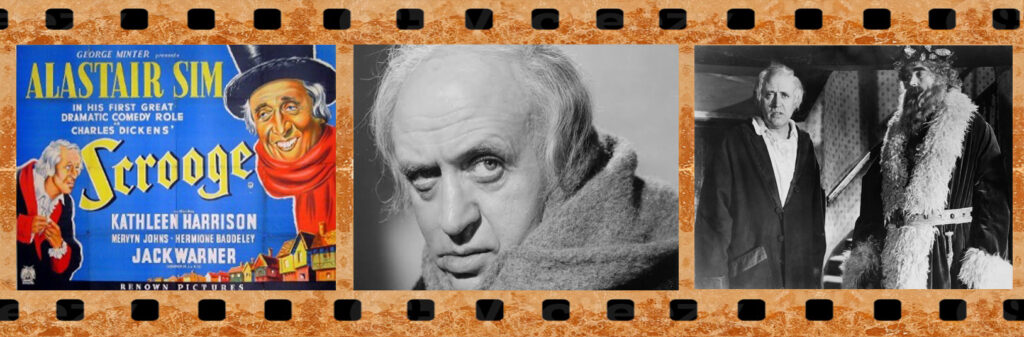
SCROOGE, 1951, set in 1843. This is has always been my favorite version. Alastair Sim is just the best Scrooge with the right amount of menace balanced with humor once he’s converted. He’s just a fun actor. I wish he’d been in more films Americans can see. This one has scary stuff. It doesn’t let you forget it is a ghost story. For instance, Ignorance and Want. The scraggly, starving children under the robes of the Ghost of Christmas Present. “This boy is Ignorance. This girl is Want. Beware them both, and all of their degree, but most of all beware this boy, for on his brow I see that written which is Doom, unless the writing be erased.” — Charles Dickens, A Christmas Carol. Boy, was Dickens ever right!
WHAT THEY GOT RIGHT: All of it. It might run long to some, to those who haven’t actually READ it, but it covers some mighty important stuff. Dickens wrote this story for a reason. He was concerned with the poor in London. The richest country/Empire in the western world, and it had all this want…and ignorance. Because of his writing this, there was a social reform wave, though it was far from doing the job. Once again, the political will was weak. Costumes and hair, all good.
WHAT THEY GOT WRONG: I can’t see much that’s wrong. They tick all the boxes for dialog and the authenticity you want from a film, within the limitations of budget. It is in black and white, which in my mind, works well for this kind of story about poverty. They probably didn’t have the budget to do it in color. Actually, doing it in sepia would have worked as well. Certainly not the candy colors of the Muppet venture.
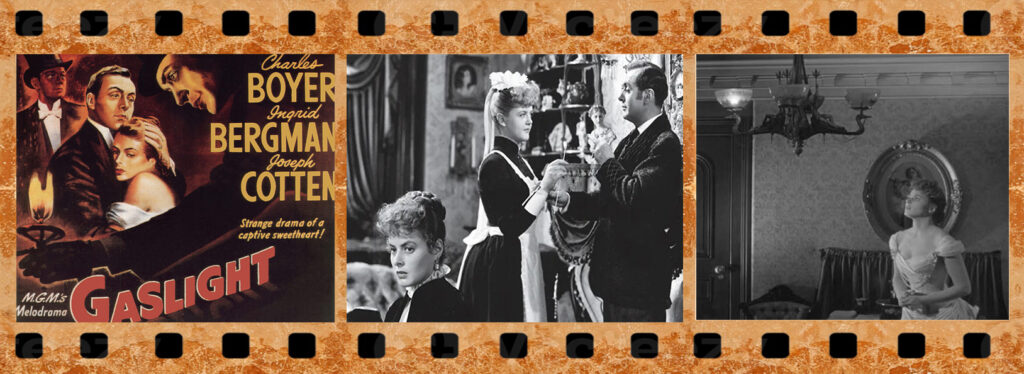
GASLIGHT, 1944, set in 1880s. This is a more in-depth remake of the 1940 version (even though the latter adheres more closely to the play), but this time with an A-list cast: Ingrid Bergman and Charles Boyer. Bergman gives the fragile nature of the wife believability (and won an Oscar for it). After all, this was the time period in England where a husband could condemn a wife to an asylum whenever he wished, and the wife could do nothing about it! Gleaned from a 1938 play, “Gas Light” by Patrick Hamilton, a psychological thriller that premiered in London and then went on to Broadway under the new title “Angel Street”, with Vincent Price playing the role as the conniving husband trying to drive his wife mad so he could find some hidden jewels and dispose of her. The title “Gaslight” comes from the wife seeing the gaslight lower and rise again all on its own (because of dastardly doings), but none of the servants have seen it do so. And very quickly gave its name to a term for trying to fool someone into questioning their own reality.
WHAT THEY GOT RIGHT: Looks like I’m mostly choosing works that do a good job with hair and costumes and art direction of populating the sets with true furnishings. And of course, the acting is amazing. This was Angela Lansbury’s first film role, for which she received an Oscar nomination as Best Supporting Actress, only 19 years olf at the time! The film won Best Picture for that year.
WHAT THEY GOT WRONG: Maybe the pacing is a bit slow, but picks up as it nears the climax. I must confess, it just isn’t one of my favorite films. I’ve only seen it a handful of times.
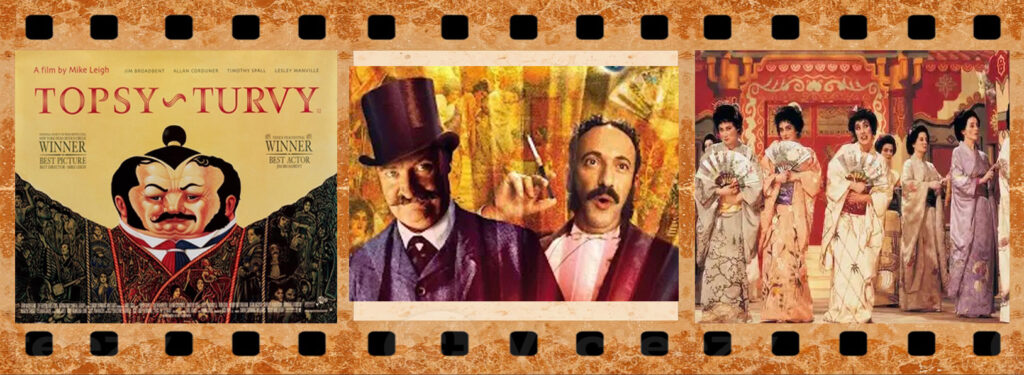
TOPSY-TURVY, 1999, set in 1884. It’s funny. I love Gilbert and Sullivan, but I did not like this film on first viewing. On future viewings I grew to love it. If you are a fan of Gilbert and Sullivan, you will find the process fascinating on how these two diverse men, dramatist W. S. Gilbert and composer Arthur Sullivan worked together, sometimes with difficulties, sometimes ecstatically, on their blockbuster comic operettas. This particular film deals with how they came to create “The Mikado”. The term “topsy-turvy” means utter disorder, upside down, and describes greatly the chaos of writing, composing, and putting on a show for discerning audiences. Well, actually, it played to many levels of society…likened to a Bugs Bunny cartoon; the kids like the frantic pace of the animated characters, and the parents like the adult jokes thrown in. And so it was in 1880 society with the foot-tapping tunes of a Gilbert and Sullivan operetta, with the social commentary fresh on offer to those in the know.
WHAT THET GOT RIGHT: Being a 1999 film, the cinematography recreates a bygone age in its filtered golden glow. The art direction is impeccable to the little details on tables and walls of Victorian sitting rooms, the problems and health of actors. It describes the wonders of the Japanese Village in Humphrey’s Hall at Albert Gate in Knightsbridge. You must remember, that Japan was closed to the west for centuries, but now they were opening the door for trade. This was a very popular cultural exhibition that ran in London from January 1885 to June 1887. Brits really knew very little about Japanese culture. Chinoiserie (Chinese) design was part of the decor in Victorian houses including screens, curtains, vases, cabinets, and art, and now there was Japonisme or Japonaiserie that cultured Brits could begin filling their drawing rooms with. It’s an excellent study of the times.
WHAT THEY GOT WRONG: I don’t quite recall what put me off at first. Maybe you have a similar experience that you can comment about below, but it has definitely grown on me.
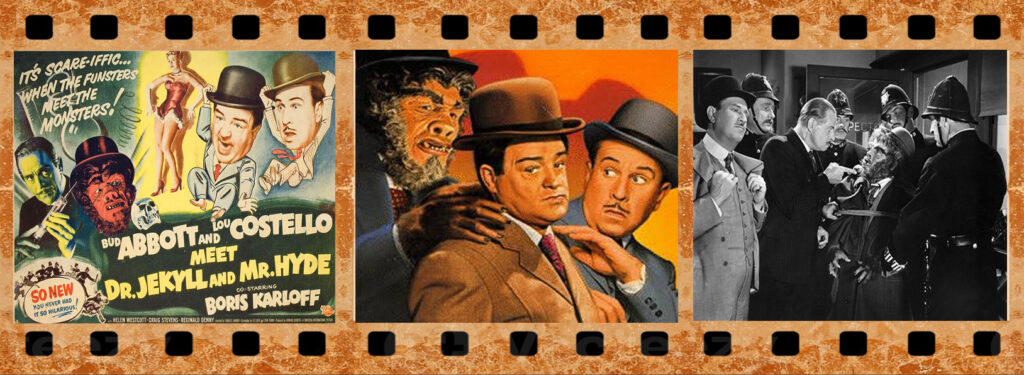
ABBOTT AND COSTELLO MEET DR. JEKYLL AND MR. HYDE, 1953, set in 1886. Yeah, I did it. I thought I’d mix it up a bit and not be too precious, and talk about…this. Well, it’s an Abbott and Costello film. Much on the same order of a Three Stooges film. Hey, don’t get me wrong, I loved both when I was a kid. But trying to watch any of these films as an adult is just…oh, it’s just so stupid. For those of you who don’t know, the comedy team of Abbott and Costello did a number of these Universal monster films, often with Boris Karloff and sometimes with Lon Chaney, Jr or Bela Lugosi. Abbott and Costello were the most popular comedy team in the 40s and 50s, working on radio, film, and television. They had first worked in burlesque as comics and got to know one another there. I was not a fan of Bud Abbott’s (the straight man) treatment of Lou Costello (the man child on the order of Jerry Lewis, or Curly of the Three Stooges). It was too mean for me. A rift came between them (fueled, no doubt, by the death of Lou’s young son. Friends and family said he was never the same), and though their comedy team continued to work, their real life relationship began to deteriorate. Even as their franchise was revitalized with these horror/comedy films, life would intervene. Lou died of a heart attack (he had fought rheumatic fever since 1943). Bud tried a new partner, but the chemistry just wasn’t there. In this outing, Bud and Lou are American police officers who lost their jobs and with the newspapers railing about these murders, they get it into their heads to capture the culprit to be reinstated in their jobs back home.
WHAT THEY GOT RIGHT: Well, if you are a fan of these films, I’m sure this is just as entertaining as all their others. Madcap chases ensue, comedy high jinx, and monsters being monsters. A live action cartoon, really. In fact, in 1966, there was a Hanna-Barbera Saturday morning cartoon that yours truly watched and liked, though can’t recall a one.
WHAT THEY GOT WRONG: As you can imagine, the costume, the way of speaking is only Victorian-lite. Does it have much to do with Robert Louis Stevenson’s novel about society’s evil and excesses? Not a whit. It’s all about the monsters, as indeed, all of their previous, and new films after it were. And all about the duo and the humor of their getting scared, and even Lou turning into his own Mr. Hyde. It got generally good reviews in its time. The Los Angeles Times said, “If Robert Louis Stevenson is turning over in his grave, it’s probably only so he can get in a more comfortable position for a belly laugh.” Make of that what you will.
STAY TUNED FOR PART 2, with TWO Sherlock Holmes features, some time-travelling, and a veritable comedic favorite.
Discover more from Jeri Westerson
Subscribe to get the latest posts sent to your email.