
Concerned for the ever-growing crime rate, Victorians were all for punishment for crimes. It was the style of this punishment that were having trouble with.
In the Mikado, a Gilbert and Sullivan comic opera from 1885, there is a song sung by the Emperor of Japan called A More Humane Mikado, with the refrain, “Let the punishment fit the crime”, for instance:
The billiard sharp who any one catches,
His doom’s extremely hard —
He’s made to dwell —
In a dungeon cell
On a spot that’s always barred.
And there he plays extravagant matches
In fitless finger-stalls
On a cloth untrue
With a twisted cue
And elliptical billiard balls!
Tame stuff compared to what prisoners really had to do.
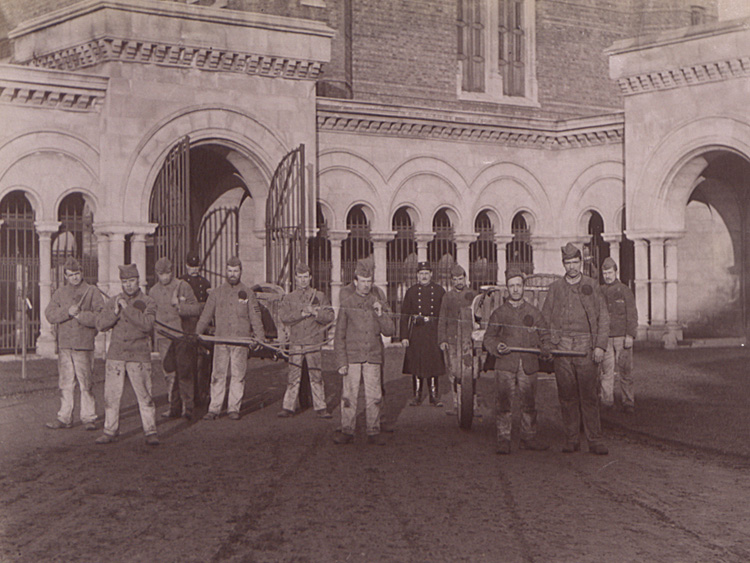
Coldbath Fields Prison was re-built from an earlier old prison facility in 1794, incarcerating men, women and children. As horrifying as that is, remember that children worked in factories as soon as they could easily follow instructions, around five years old. The idea of children living in a golden childhood of play didn’t come till much, much later.
This prison served most of the convicted of London.
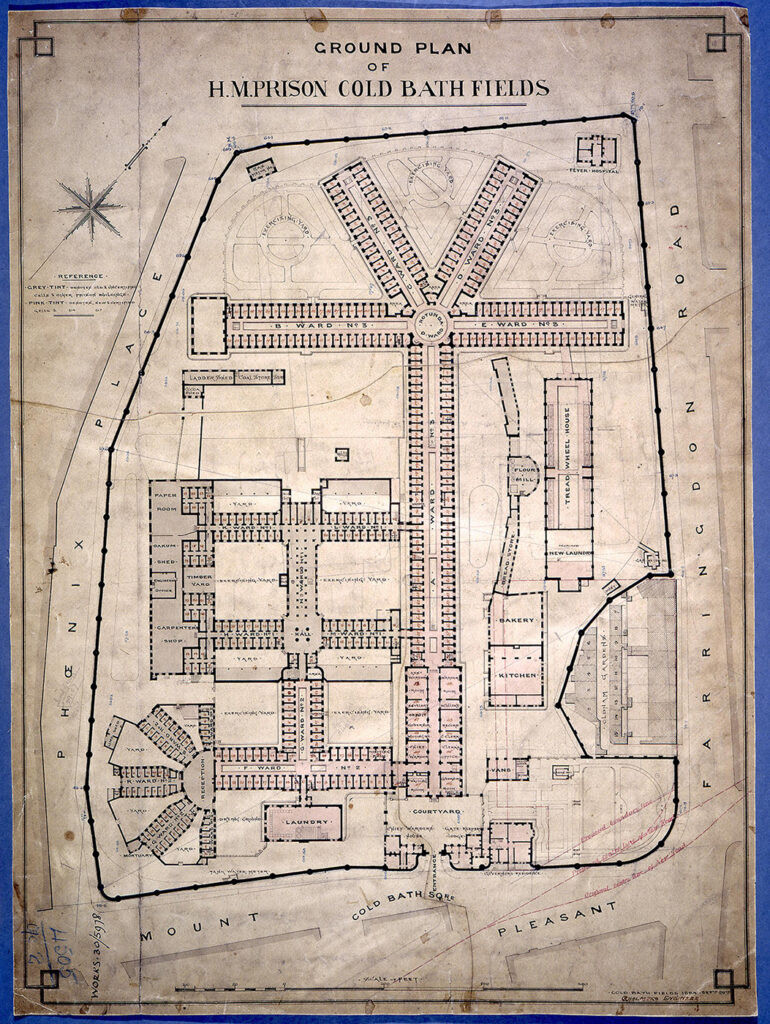
Look at the size of this place! The grey parts are the oldest parts of the prison, while the pink parts are the newest, from 1884. Just HOW to punish criminals was the biggest problem of the era.
The penal treadmill was one of those punishments. It was simple and effective. In the Middle Ages they used these sorts of wheels to build cathedrals using them as pulleys to bring up large stones. It was a large wheel like a hamster wheel but for men to walk within it, but treadmills as such or waterwheels were as old as ancient Egypt for bringing water up from the Nile into the fields. The ones in prisons were slightly different from the king-sized hamster wheels from days of yore. You would stand atop this gear-like structure to walk for ten minutes, then five minutes rest, for a total of eight hours a day, walking the equivalent of over 8,000 feet in the process. If you fell, you can imagine that you would be ground into that night’s supper. Mercifully (if you can use that word), there was a bar in the front to hold on to.
When Oscar Wilde lost his lawsuit against the Marquis of Queensberry for slander, he did this as his punishment as well as being condemned for homosexuality.
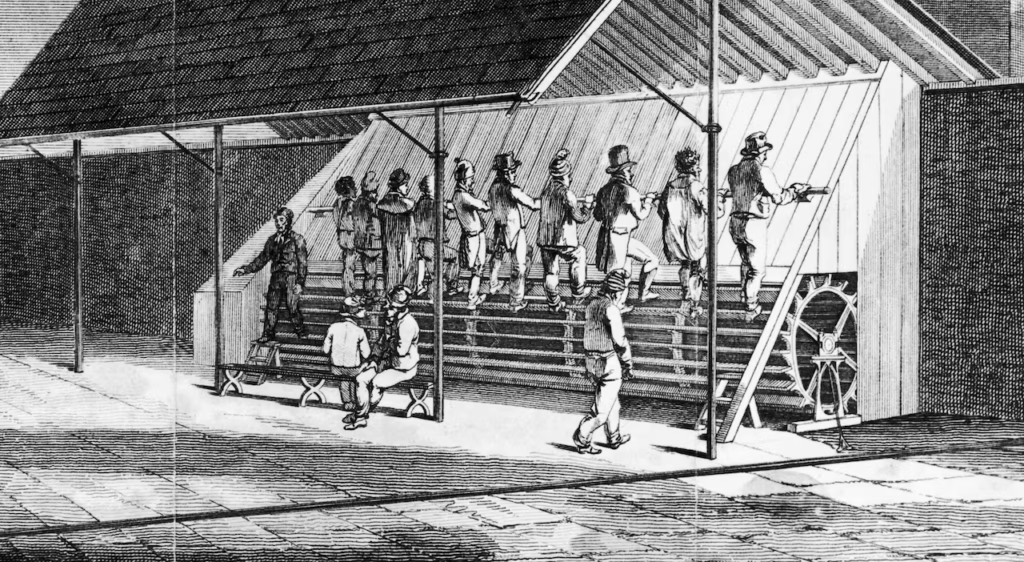
Strange that we use something similar today for exercise!
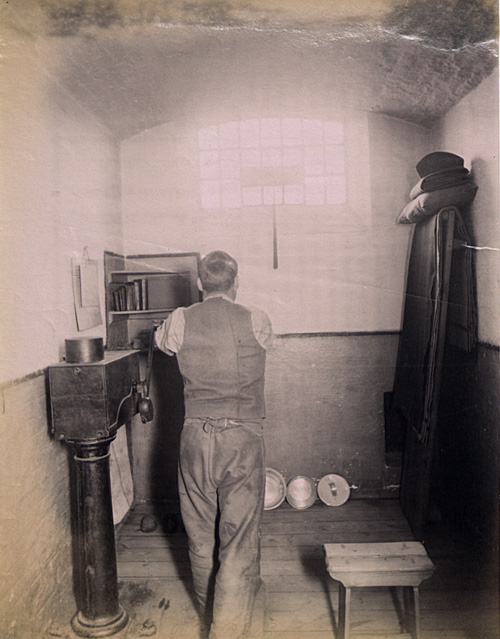
Photograph of prisoner at hard labour in his cell at Wormwood Scrubs Prison
The prisoners on the treadmill sometimes powered other machinery in the prison, like water pumps. But sometimes they did nothing at all. The fellow directly above is doing hard labour in his cell, turning a crank. He had to turn the crank a set number of times in order to earn his food! But unlike some of the treadmills, this did nothing but serve as punishment. It operated a series of paddles in a box of sand.
Below is the prison record for Mary McDonald, and below that is the transcript for easier reading.
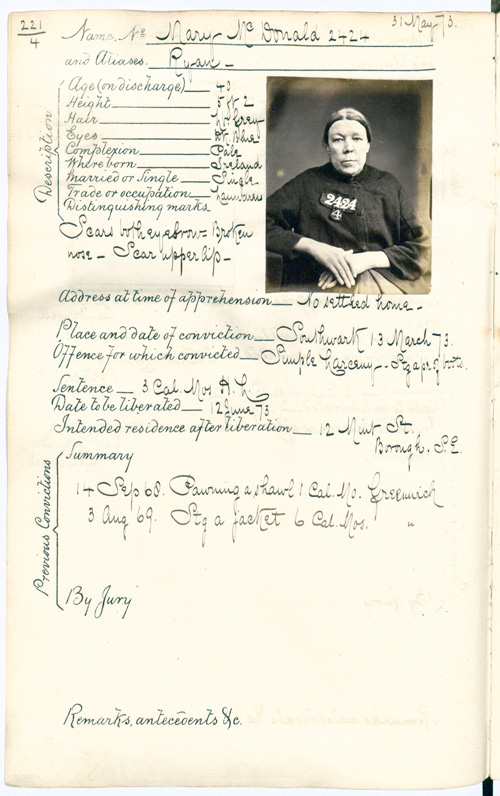
You can see from the transcript below that she was a homeless laundress and was arrested for stealing boots, and I imagine they were to clothe herself with, including those previous convictions for stealing a shawl and a jacket.
Name No – Mary McDonald 2424
and Aliases – Ryan
Description Age (on discharge) 40
Height ________________5ft 2
Hair __________________L Grey
Eyes _________________D Blue
Complexion ____________Pale
Where born ___________ Ireland
Married or Single _______Single
Trade or occupation _____Laundress
Distinguishing marks – Scars both eyebrows Broken nose – Scar upper lip
Address at time of apprehension – No settled home
Place and date of conviction – Southwark 13 March 1873
Offence for which convicted – Simple Larceny – St[ealin]g a p[ai]r of boots
Sentence – 3 Cal[endar] Mo[nth]s H[ard] L[abour]
Date to be liberated – 12 June 1873
Intended residence after liberation – 12 Mint St Borough S.E.
Previous Convictions:
14 Sep 68 Pawning a shawl 1 Cal[endar] Mo[nth] Greenwich
3 Aug 69 St[ealin]g a jacket 6 Cal[endar] Mo[nth]s ” By Jury
Some castles served as prisons, like Lincoln Castle in the county of Lincolnshire. These imposing structures were designed in the “separate system”, an isolating scheme that kept prisoners apart from the “corrupting influence of their fellow prisoners.” It was the worst kind of prison, where the cells were often dark, sometimes with no windows and no fresh air, unwholesome conditions where there was cold, dark, and damp, with little food.
The Victorians were of the belief that this strict deprivation would make them reflect and reform. Even when they were in the chapel they were ensconced in little booths so that they could only see the preacher and not any other inmate. As one can imagine, it did little but drive them insane.
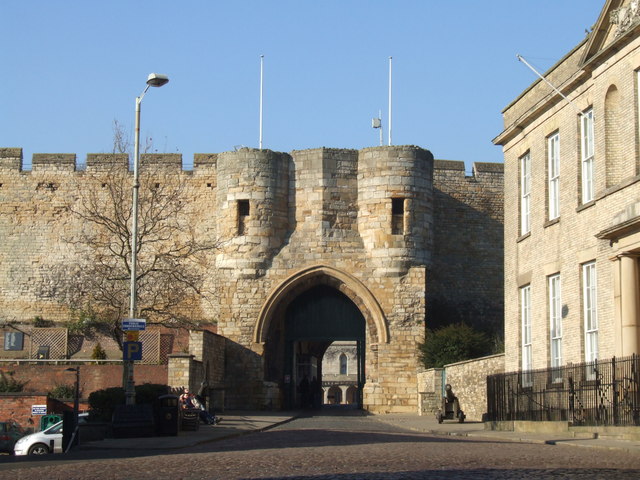
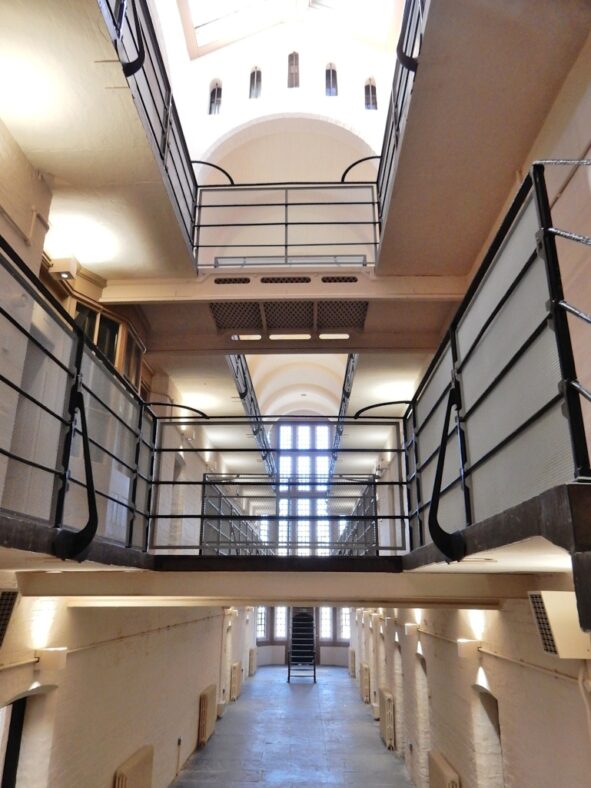
The prison is closed to prisoners today, and is now a tourist attraction. But you might recognize the above today featured on many a British crime drama.
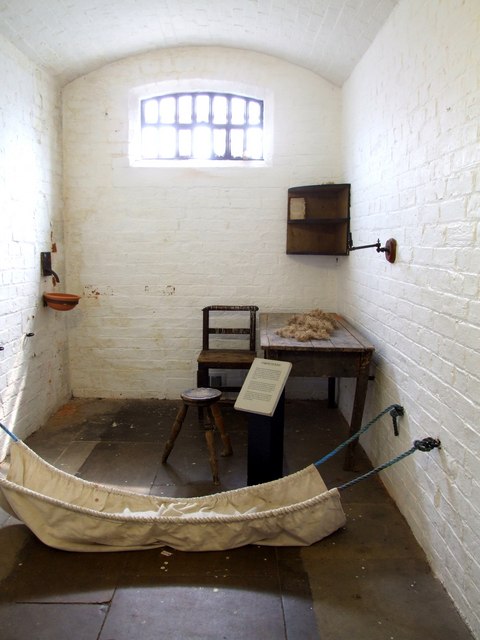
One of the brighter cells. But there were far darker cells that could be accessed by little more than a hole in the wall.
This isolation proved to be a poor strategy for preparing a convict for a better life once released. By 1878, the system was finally discredited, and the inmates were transferred to the new jail in the eastern outskirts of Lincoln.
In 1895, there were 39 treadmills and 29 cranks in English prisons, which had decreased to 13 treadmills and 5 cranks by 1901. Penal treadwheels were abolished in Britain in 1902 by the Prison Act 1898.
Discover more from Jeri Westerson
Subscribe to get the latest posts sent to your email.