Maybe she read some books, but many of her critics didn’t think so. According to Time Magazine, she reviewed 4-6 books a day! Overall, by the time of her death in 2015, she had reviewed 31,014 books, most of which were on Amazon.
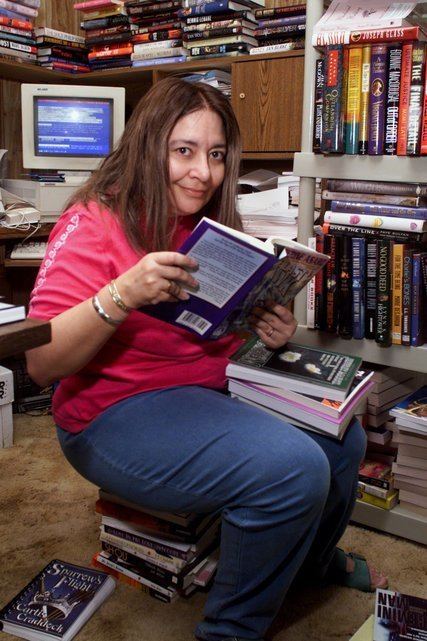
Let’s go back a bit to the early 2000s. There was a woman named Harriet Klausner who was an amatuer reviewer, some say columnist and librarian. But some didn’t even think she was a real person. Had A.I. been a thing back then, one might have attributed her output to a computer. She offered mostly 4-5 star reviews, seeming to like the majority of the books she reviewed. She got so popular that publishers would send her books to review. She claimed in an interview for the Wall Street Journal in October of 2007, that her main goal was to bring attention to “lesser-known” authors who “don’t have a publicity machine behind them. That’s the whole purpose of my doing this on Amazon.”
But the publicity machine began pursuing her. In the beginning, I guess it didn’t matter to publicists at traditional publishing houses that her output was exceptional. Too exceptional. But they kept sending her books, and she kept reviewing them. Was she paid to? That has always been unclear. Did she actually speed read her way through four to six books a day? I don’t think so, and I’ll tell you why. Because back in the day, she reviewed one of my Crispin Guest Medieval Noir books when the first six were published by St. Martin’s, one of the big New York publishers. And though authors may not turn away or report a good review, when I heard of this Harriet Klausner, and then I discovered that she reviewed one of my books in about 2010, it was clear to me that she had not read it. What she used for her review was the sales materials my publicist sent out, and I knew this because some of the info in the press release was WRONG. And that inaccurate description was repeated in her review as if it WERE IN THE BOOK. Which it wasn’t.
And I suppose this brings up the crux of it; Is this kind of review worth having? Is it just another star you can turn to and say, “Look! They loved the book!” Because, in the end, that’s what reviews are for. Publishers and authors love to use pull quotes from blurbs/reviews to use on their book covers and collateral materials, like bookmarks. Publicists like to include them in the publisher’s catalogues that go out to bookstores and libraries. But is this kind of review at all valuable when the reviewer is, well, for want of a better word, a public joke to the industry? Does it truly reflect the accuracy of the book?
Harriet died in 2015, and I don’t know if her family talks too much about her legacy. In the years she reviewed (I won’t say READ and reviewed), she was the #1 ranked reviewer on Amazon for a number of years, and at the time of her death held the No. 1 spot in Amazon’s reviewer “Hall of Fame”. According to Quartz.com in a 2022 article,
“Amazon has made efforts to crack down on fake reviews in the past—since 2008 the company has made changes to the algorithm for what’s considered a “top reviewer,” and Klausner, who once held the #1 spot, has since dropped to 2,423, as of this writing [in 2022]. Earlier this month Amazon sued more than 1000 people for allegedly leaving fake reviews in exchange for $5.”
I don’t know if my Harriet Klausner review is still up. I can’t quite recall which book it was (hey, those were from 2008 to 2013), but it is safe to say, that authors should never pay for reviews. What an author wants are real readers, librarians, bloggers, and professional reviewers telling the public about this book they read, and, hopefully, how much they enjoyed it.
Discover more from Jeri Westerson
Subscribe to get the latest posts sent to your email.
That’s just wild! I wonder what she got out of it. Why get free books if you don’t read the books!
Yes, she got free books. And possibly sold them.
People these days. Jeez
What was she getting out of it that made her keep doing this everyday? It can’t be the likes cause those are few and far between. This story made me go back and check my Amazon reviews. At a quick glance, the most likes I got was 8 for a non-book related item. About 90 percent of my reviews over the years got no reaction at all. Which is okay because I started leaving reviews for myself, to state what I liked (or not liked). File this under “people are strange”…
Just the recognition, perhaps. Maybe her article writing wasn’t all that good. I mean, this kind of thing is worth as much as A.I. reviewing me.
I am still so in love with Crispin guest
I’m glad. He’s definitely the founder of the feast of my writing career.